The
Modern Chapel of the Wounded Jesus in Zagreb: An Architecture of Silence in the
Heart of the City
La moderna capilla de Jesús Herido en Zagreb. Una arquitectura del silencio en el corazón de la ciudad
Zorana Sokol-Gojnik
· University of Zagreb (Croatia) · zorana.sokol@arhitekt.hr
· https://orcid.org/0000-0002-2148-2243
Igor Gojnik
· Independent Scholar, Zagreb (Croatia) · igor.gojnik@siloueta.hr
· https://orcid.org/0000-0002-5338-6539
Recibido:
02/12/2025
Aceptado:
23/12/2025
Abstract
The Chapel
of the Wounded Christ in Zagreb, designed by Antun Urlich in 1936, represents a
rare example of modernist sacred architecture integrated within the city’s
historic core. Conceived as an architecture of silence, the chapel
transforms light, proportion, and material into carriers of spiritual meaning.
Embedded in the Foundation Building on Ban Jelacic Square, it contrasts the
noise of urban life with an inner atmosphere of contemplation. The research
interprets the chapel as both architectural and theological innovation, linking
Croatian modernism with wider European movements that sought new expressions of
the sacred through simplicity and clarity. Urlich’s minimal composition —stone,
glass, and light— creates a space where modern rationalism meets transcendence.
The chapel stands as a lasting dialogue between faith and modernity, proving
that silence and light can become the true language of sacred architecture
within the heart of the modern city.
Keywords
Antun
Urlich, Croatia, Modern Architecture, Sacred Architecture, Zagreb.
Resumen
La capilla del Cristo Herido de Zagreb, diseñada por Antun Urlich en 1936, representa un ejemplo excepcional de arquitectura sacra moderna integrada en el centro histórico de la ciudad. Concebida como una arquitectura del silencio, la capilla transforma la luz, la proporción y la materia en portadores de significado espiritual. Integrada en el Foundation Building, en la plaza Ban Jelacic, contrasta el bullicio de la vida urbana con una atmósfera interior de contemplación. La investigación interpreta la capilla como una innovación tanto arquitectónica como teológica, vinculando la modernidad croata con movimientos europeos más amplios que buscaban nuevas expresiones de lo sagrado a través de la simplicidad y la claridad. La composición minimalista de Urlich (piedra, vidrio y luz) crea un espacio donde el racionalismo moderno se encuentra con la trascendencia. La capilla se erige como un diálogo duradero entre la fe y la modernidad, demostrando que el silencio y la luz pueden convertirse en el verdadero lenguaje de la arquitectura sacra en el corazón de la ciudad moderna.
Palabras clave
Antun Urlich, arquitectura moderna, arquitectura sacra, Croacia, Zagreb.
Introduction
The Chapel
of the Wounded Christ in Zagreb is a unique example of modernist sacred architecture,
located in the historic centre of the city. Situated at Ilica 1, on the ground
floor of the Foundation Building next to Ban Jelacic Square, it is
simultaneously present and hidden. It forms part of the everyday rhythm of
urban life, yet remains a space of silence and contemplation.
The main
aim of this paper is to explore the architectural, spiritual, and urban
identity of the modern Chapel of the Wounded Christ, with particular emphasis
on the concept of silence, which in this chapel acquires a spatial and symbolic
dimension. The chapel is considered not merely as a building, but as a
spiritual phenomenon within the fabric of the modern city, where silence
—contrasting the external noise— becomes an architectural principle, and space
itself a symbol of divine presence.
The
research is based on the analysis of archival documents, [1] a review of existing literature on
the chapel, visual and spatial analysis of the site itself, and a comparative
study with other modernist sacred buildings in Croatia and Central Europe from
the 1930s (Fernández-Cobián 2007). Professional literature in the fields of
architectural history, the liturgical movement, and the theology of space
provides the framework within which the Chapel of the Wounded Christ is placed
in the broader context of European modernism.
Continuity of the Site
The origins
of the chapel date back to 1749, when the first chapel dedicated to the
Suffering Christ (Trpeci Isus) was built beside the Manduševac spring, with
the permission of Bishop Franjo Klobusic. Due to urban redevelopment and the
construction of the Foundation Hospital, the chapel was demolished in 1794, and
a new one was erected within the hospital complex that same year. Throughout
the 19th century, the chapel and hospital became inseparable parts of the
city’s identity, a meeting place of civic care and spiritual devotion (Fig.
01).
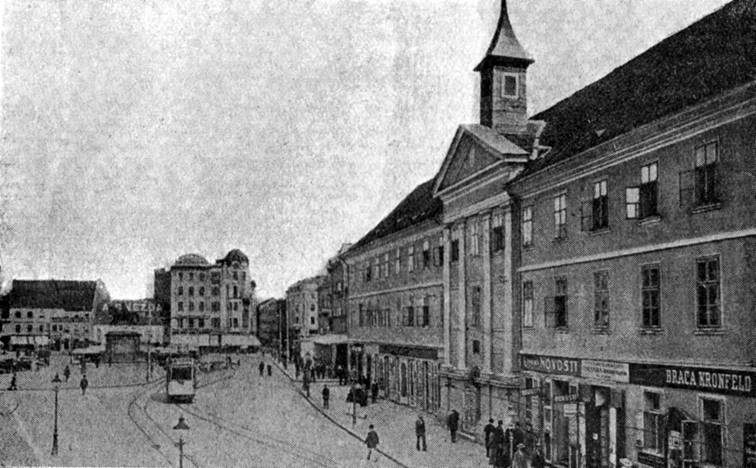
Fig. 01. The first
Chapel of the Suffering Christ on Ban Jelacic Square, Zagreb (Croatia), 1749;
demolished in 1794.
In 1803,
Bishop Maksimilijan Vrhovec entrusted the administration of the hospital and
chapel to the Order of the Brothers Hospitallers (Šegvic 1938). After the Order
left in 1918, the hospital was taken over by the City of Zagreb, but the
complex soon became inadequate for modern medical needs. Consequently, it was
decided to demolish the old hospital and build a new Foundation Block, a mixed
residential and commercial complex.
Through the
initiative of the chapel rector, Kerubin Šegvic, and the Foundation Board, it
was decided that a modern Chapel of the Suffering Christ would be incorporated
into the new building. Authors of residential building with the chapel were
Antun Urlich, Franjo Bahovec and Ivo Juranovic. According to archival records,
in 1934 architect Antun Urlich undertook the design of the new chapel. [2] The chapel was consecrated on
August 16, 1936, by decree of the Archiepiscopal Spiritual Court, thus
continuing the spiritual lineage from 1749 into the modern era. The
reconstruction of the chapel within the new structure represented both an
architectural reinterpretation and a theological affirmation, a transformation
of baroque devotion into a modernist architecture of silence.
The chapel,
although situated in the very heart of the city’s bustle, functions as an inner
counterpart to the external world. While traffic, commerce, and daily noise
flow outside its walls, within reigns a silence of light and sound. This
silence is not an absence, but a place of Presence, a space of contemplation
and meditation leading to an encounter with God (Fig. 02).
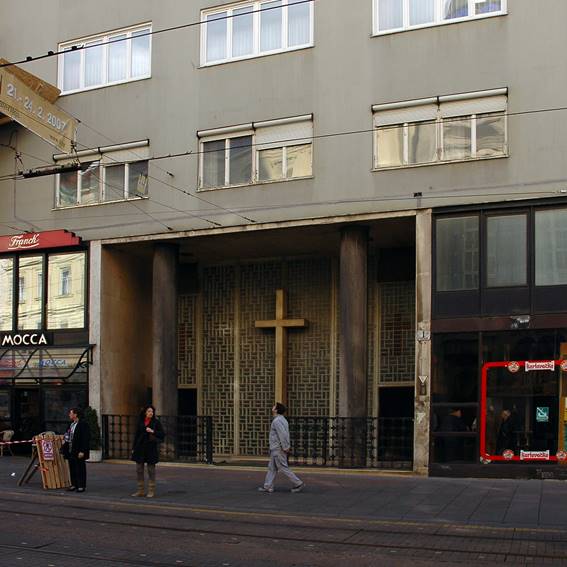
Fig. 02. Antun
Urlich, Chapel of the Wounded Jesus, Zagreb (Croatia), 1934-36; entrance facade
to the chapel.
Architect Urlich
did not design a monumental sanctuary, but rather an urban interior of
spirituality, an architecture that speaks the language of proportion, measure,
and light. In this sense, the Chapel of the Wounded Christ becomes a metaphor
of the modern city, a space that distills meaning from the surrounding noise.
It reflects what Vesna Mikic (2002) calls the «classicism of modernity», a
quiet discipline of form that transforms material into a space of spirit.
Zagreb in the 1930s: The City and the Rhythm of Modernism
During the
1930s, Zagreb underwent a period of intense modernization (Premerl 1990). The
city center, shaped in the 19th century within the spirit of historicism,
experienced a redefinition of its functions, façades, and spatial relations.
The 1930s
represent one of the most significant phases in the formation of modern Zagreb.
After the First World War, the city expanded rapidly: its population grew,
industry developed, and central urban areas demanded new spatial solutions. The
traditional urban matrix, dominated by monumental historicist buildings of the
late 19th century, increasingly failed to meet the functional requirements of
modern life. Within this context, modernism emerged as an architectural and
urban movement that found strong resonance in Zagreb (Radovic Mahecic 2007).
A central
role in shaping interwar Zagreb was played by the so-called Zagreb School of
Modern Architecture, a group of architects associated with Professor Drago
Ibler and the artistic collective Zemlja (Earth). Among its leading members
were Stjepan Planic, Drago Ibler, Drago Galic, Zlatko Neumann, Mladen
Kauzlaric, and others. Their work was characterized by faith in rationality,
functionality, and the social responsibility of architecture. In contrast to
Vienna Secession and late historicism, which had defined earlier decades,
modern architecture sought liberation from ornament and form shaped according
to the real needs of everyday life.
The
interwar period (Laslo 1982 and 1987) laid the foundations of 20th-century Croatian
architecture (Ivankovic 2016), during which Zagreb became a truly European
city, with achievements comparable to those of Vienna, Prague, or Budapest.
Modernism in Zagreb was both local and international: local in its sensitivity
to the urban and social context, and international in its engagement with
broader European currents.
One of the
key urban issues of the time was the so-called problem of closed city blocks.
While the city expanded eastward and southward, the 19th-century central
districts remained burdened by large enclosed blocks with internal courtyards.
These often housed inadequate auxiliary dwellings, lacking light, air, and
permeability between streets (Ivancevic 1983).
Architects
of the Zagreb School saw modernism as the solution to this problem. Instead of
closed blocks, they proposed semi-open and permeable ensembles with arcades,
inner courtyards, and green spaces—responding not only to functional needs but
also to the social idea of the city as a place of openness and communication.
The most
complete example of modernist urbanism in Zagreb became the Foundation Block (Zakladni
blok), built between 1932 and 1937 on the site of the demolished Hospital
of Brothers Hospitallers. On this site unfolded the drama of demolishing
the old Hospital and its chapel and erecting a new modern complex (Bjažic
Klarin 2010). Today, this ensemble is a protected cultural monument and one of
the most significant examples of the International Style in Croatia (Fig.
03-04).
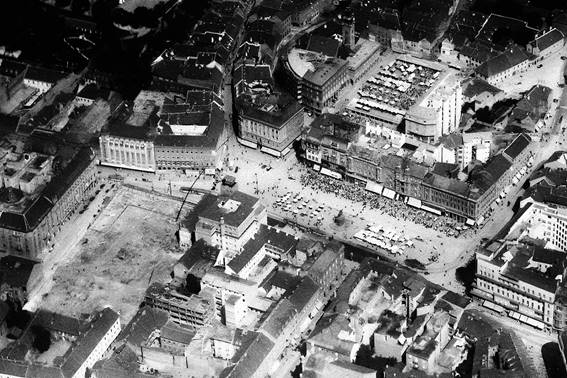
Fig. 03. The
site of the demolished Hospital of the Brothers of Charity, Zagreb (Croatia),
1932.
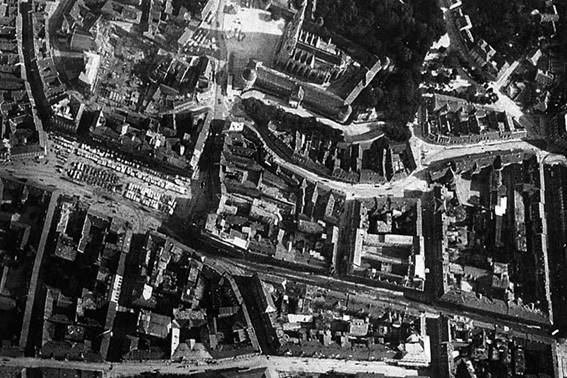
Fig. 04. The
location of the demolished hospital on a larger scale, 1932.
Following
the Hospital’s demolition in 1931, the city authorities announced, in 1929-30,
an open architectural competition for the parceling and design of this
prestigious location. The aim was to develop a urbanistic regulatory plan
defining the volume, height, and uniform appearance of the new block. The competition
attracted the leading architects of the period, including Drago Ibler, Stjepan
Planic, Josip Seissel, Josip Picman, Ernest Weissmann, and others.
The
subsequent debates in professional journals and daily newspapers revealed a
deep divide between conservative and modernist tendencies. Conservative critics
mocked the proposals as bare cubes and architectural fashions,
while modernists advocated for radical solutions — from megastructures spanning
Ilica Street to a proposed 42-meter-high tower (Bjažic Klarin 2010).
Ultimately,
a compromise solution was adopted: the regulatory plan from January 1930
combined elements from several competition entries. It prescribed the
construction of a unified block comprising nine buildings and a tower, with
strictly defined heights and façades to ensure visual coherence. Between 1932
and 1937, the Foundation Block was realized, bounded by Gajeva, Ilica,
Petriceva, and Bogoviceva Streets. This complex of mixed-use buildings is
regarded as the largest manifestation of the International Style in Zagreb’s
Lower Town (Donji grad).
The block
was built according to the principles of modern urbanism: clearly defined
volumes, rhythmic façades, glass shopfronts at street level, and rational
organization of residential and commercial spaces. Although conceived as a
unified whole, the final result was somewhat compromised: different investors
and architects had to comply with the prescribed parameters, leading to a
certain monotony, yet also to a coherent visual identity (Fig. 05).
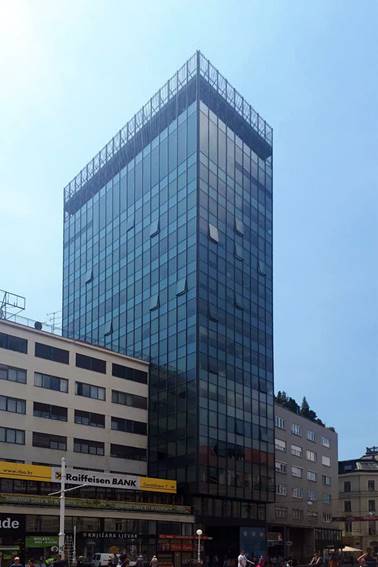
Fig. 05. Antun
Urlich, Franjo Bahovec and Ivo Juranovic, New building built on the site of a demolished
hospital, Zagreb (Croatia), 1934-36; on the far right.
Ban Jelacic
Square thus became not only a traffic hub but also a symbolic center of the
city, a place of daily encounters, commerce, and the representation of modern
urban life.
In the
context of modernization, there arose a need for continuity of the spiritual
space that citizens had on that site since 1749, when the first Chapel of the
Suffering Jesus was built. The new Chapel of the Wounded Jesus (the name
changed from Suffering to Wounded) was realized within the Foundation Block, as
part of a residential building designed by architects Antun Ulrich, Franjo
Bahovec, and Ivo Juranovic. It was a response to this need, driven by the
strong desire of the citizens to restore a space deeply woven into their
spiritual life.
On the
initiative of Rector Kerubin Šegvic and with the approval of the Archiepiscopal
Spiritual Court, the new chapel was built in 1934. Its position as a sacred
space within a public building constituted a rare typological case in Croatian
interwar architecture. The chapel was conceived not as a hospital chapel, but
as a public sacred space: a place inviting meditation, pause, and
introspection, accessible to citizens, passers-by, and employees of the
Foundation.
Located
directly adjacent to the city’s busiest square, the chapel stands both at the
heart of urban life and apart from it. The sounds of the city —footsteps,
trams, voices— are subdued within its walls, creating a sense of spatial
isolation without physical distance. The chapel is entered directly from the
street, yet it is embedded within the structure of the block in such a way that
its zenithal opening brings natural light into the interior, animating the
architecture and giving it a spiritual dimension. Thus, the Chapel of the
Wounded Christ becomes an oasis of silence, light, and modernist architecture
in the very heart of the city.
The Modern Chapel of the Wounded Christ: The
Architecture of Silence
The chapel
was built within a residential building designed by Antun Ulrich, Franjo
Bahovec, and Ivo Juranovic, while the chapel itself was built according to the
design of architect Antun Ulrich, one of the prominent figures of Croatian
modernism in the interwar period. Ulrich belonged to the generation of
architects who introduced new spatial concepts, rationalism, and a disciplined
functional form to Zagreb, yet without renouncing the humanistic sensibility of
space (Mikic 2002) (Fig. 06).
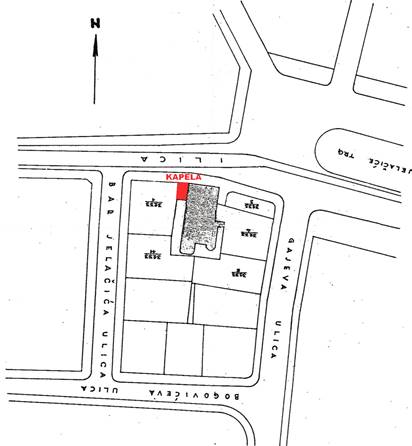
Fig. 06. The
position of the Chapel of the Wounded Jesus on the site.
Urlich’s
modernist architecture, rooted in the Viennese architectural school, is based
on a disciplined, rational, and measured form derived from the classical
principles of proportion, order, and balance. His architecture aspires to
simplicity and constructive clarity. Instead of ornament, the main bearers of
expression are material and light; space is shaped as experience rather than
decoration (Fig. 07-08).
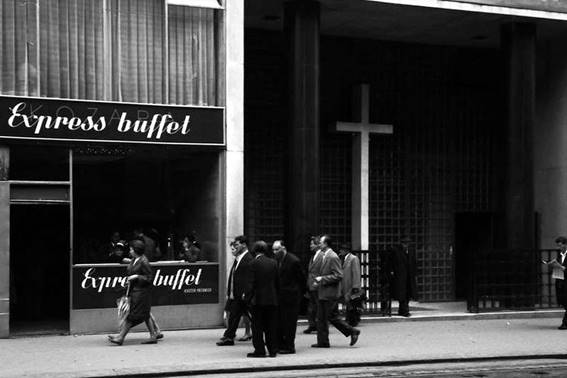
Fig. 07. Antun
Urlich, Chapel of the Wounded Jesus, Zagreb (Croatia), 1934-36; he entrance
facade (photo from the time of construction).
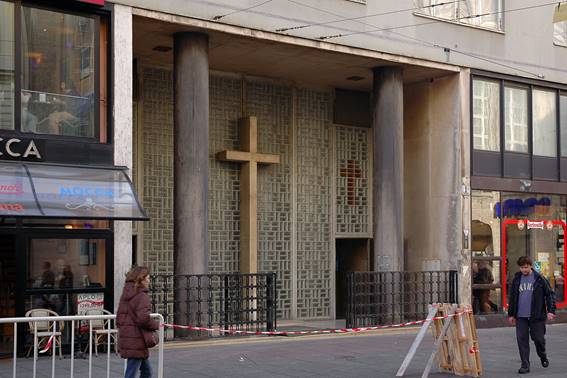
Fig. 08. The
entrance façade today.
In this
chapel, too, Urlich does not design a monumental church but rather a quiet
sanctuary within an urban building, following modernist principles of function
and restraint. On the façade, within the clean modernist grid of the Foundation
Building, a delicate white stone frame defines the boundary of the sacred
space. This frame is not decorative but precisely marks the threshold between
the sacred and the profane. The structural constraint of the building —the two
load-bearing columns— becomes a compositional motif of the façade.
In contrast
to the white frame, Urlich renders them in black, creating a strong visual
rhythm and counterpoint that leads the observer into the interior. Together,
the white frame and the black columns form a forecourt: a vestibule of silence,
a transitional zone between the noise of the city and the stillness of
devotion.
The
entrance façade itself is constructed of glass brick, arranged in six vertical
fields. In the center of the composition, between the two black columns, a
white stone cross is affixed to the glass surface: a point of repose and a
striking symbol of spiritual focus.
The entire
composition —white frame, black columns, white cross, and glass panels—
embodies Urlich’s modernist discipline: purity, proportion, order, and measure.
In this geometry of silence, material and light replace ornament, and
construction itself becomes a bearer of sacred meaning (Fig. 09).
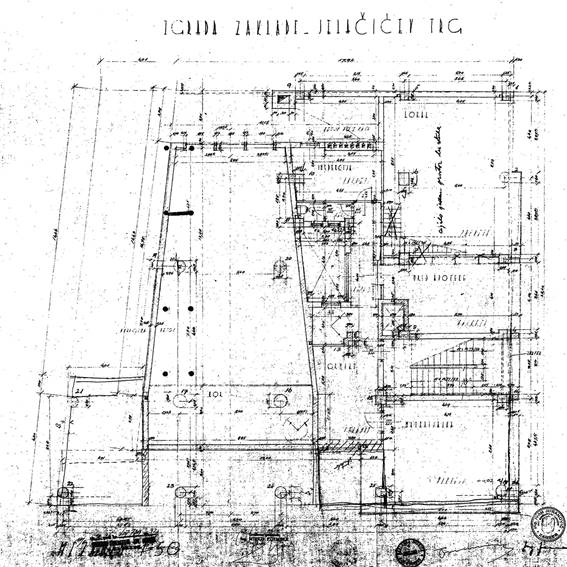
Fig. 09. Antun
Urlich, Chapel of the Wounded Jesus, Zagreb (Croatia), 1934-36; plan.
The glass
façade does not conceal but invites revelation of the interior. Glass, by its
nature, connects rather than separates; here, it admits light into the space.
The theme of light becomes the leitmotif of the architecture. Both the façade
and the rear wall of the presbytery define the spatial experience. The plan of
the chapel is trapezoidal, with two opposing glass walls through which light
enters, transformed through stained, glassimparting to the interior a sacred
atmosphere of peace and contemplation. The light of the chapel is soft,
discreet, and non-dramatic; it does not illuminate but rather invites the
discovery of divine Presence. In this way, glass and light become the primary
bearers of the sacred ambiance and spiritual experience. The space is shaped as
a materialization of silence, where the perception of sound and light turns
into a meditative encounter.
Crossing
the threshold into the chapel’s interior, the modernist principle continues
with quiet consistency. Behind the entrance glows the gentle illumination of
the stained glass window depicting Christ in the Garden of Gethsemane. The
image leads the visitor into the space dedicated to the Wounded Christ. On one
side stands Gethsemane, on the other Golgotha together forming a theological
unity of Christ’s suffering and redemption (Fig. 10-11).
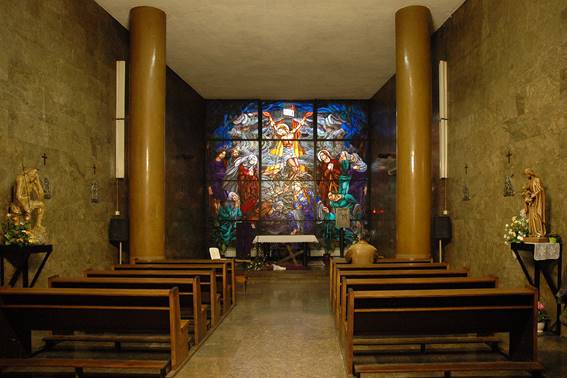
Fig. 10. Antun
Urlich, Chapel of the Wounded Jesus, Zagreb (Croatia), 1934-36; view of the
presbytery.
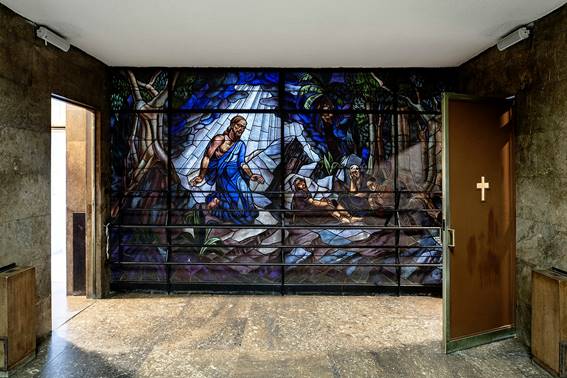
Fig. 11. View
of the atrium.
Before the
visitor unfolds a total, unified space, where only two columns —again structural
necessities— create a subtle hierarchical distinction between the nave and the
presbytery. The whiteness of the entrance vestibule continues across the
ceiling into the darker interior, where the walls and floor are clad in dark
marble. The focus of perception is drawn toward the rear wall of the
presbytery, entirely filled with a stained-glass window depicting Christ on
Golgotha.
The stained
glass was the result of collaboration between architect Antun Urlich and
painter Marijan Trepše, with the support of famous artist Jozo Kljakovic. [3] Into the monochromatic
architectural palette, Trepše introduces a dramatic chromatic composition that
gradually fades toward the edges, blending into the dark marble walls.
At the luminous center stands the crucified Christ, beneath whose cross appear
Mary-Mother of Christ, Mary Magdalene and Mary of Clopas. This scene, suffused
with light and color, becomes an icon of transcendence, the focal point where
architecture, light, and faith converge.
The
presbytery space is elevated by only two steps above the nave. This slight
elevation reflects the liturgical movements of the early 20th century (Sokol
Gojnik 2017), which sought to affirm the communal dimension of the celebration
of faith by reducing the historical height difference between the presbytery
and the space of the congregation.
Archival
documents mention the clergy’s dissatisfaction with this modest elevation and
proposals to raise the altar further; however, these proposals were ultimately
rejected. Photographic documentation from the time of the original arrangement
has not been preserved, and the available drawings do not indicate the
architectural solution of the presbytery. Nevertheless, archival sources
mention an altar supported by columns, which was later adapted to the new
liturgy introduced by the Second Vatican Council, with the mensa
replaced by a smaller one. It is likely that the pre-conciliar altar (identical
to the present one) was positioned adjacent to the stained-glass window (NDS
3528/1972).
With its
minimalist design, the altar followed the formal stylistic vocabulary of the
architectural composition. The white mensa rested on five elegant black
columns. After the Second Vatican Council, the altar was moved closer to the
nave, the mensa was reduced in size, and on the black column identified in
archival documents as «the fifth altar column beneath the tabernacle», a
freestanding tabernacle was placed (NDS 3318/1960 and 3528/1972) (Fig. 12). [4]
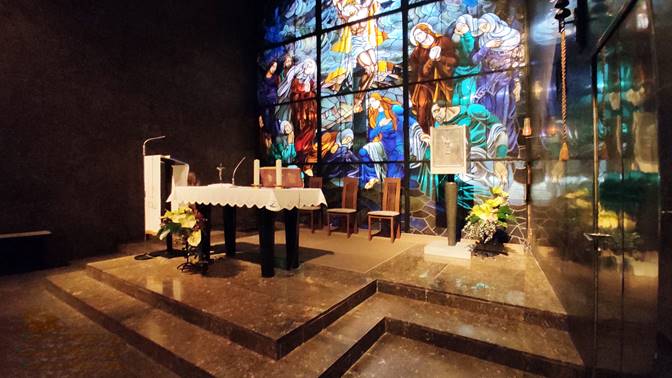
Fig. 12. Antun
Urlich, Chapel of the Wounded Jesus, Zagreb (Croatia), 1934-36; detail of the
presbytery.
The floor
was executed in dark stone paving made of rasotica stone. Architect Ulrich
ceased work on the project on May 2, 1936, and documentation indicate that the
chapel remained unfinished. [5] The chapel was blessed on August
16, 1936.
Archival
data indicate that the area of the congregation and the presbytery were
originally separated by a stone communion rail, and that the chapel underwent
several phases of refurbishment during the 20th century. In 1950, wooden pews
and confessionals were installed, introducing a warm tactile contrast to the
predominant materials of stone and glass (NDS 3528/1972).
In 1969,
the statue of the Suffering Christ, preserved from earlier chapels, was placed
in the nave on a modest pedestal. [6] The walls feature discreet Stations
of the Cross.
The most
recent major renovation of the chapel began in 2024 and is currently ongoing.
The focus of the restoration is on providing an appropriate lighting solution
and addressing technical and functional deficiencies of the chapel, while
preserving all elements of the original design. The restoration is being
carried out by architects Igor Gojnik and Zorana Sokol Gojnik.
The Chapel of the Wounded Christ in the European
Context
The Chapel
of the Wounded Christ in Zagreb, though spatially modest and discreetly
situated on the ground floor of an urban building, raises questions that
transcend its local setting. It belongs to the broader European modernist
movement which, in the first half of the 20th century, sought a new expression
of the sacred: one liberated from historical styles and material rhetoric
(Premerl 1994). This search reflects a desire to express the sacred not through
monumentality, but through spatial clarity, proportion, and light as the
primary carriers of meaning. Thus, contemporary sacred space is defined through
light, matter, emptiness and silence, not through figurative or decorative
programs (Gonçalves 2017).
What Ulrich’s
chapel shares with European modernism is the conviction that sacred
architecture is not constructed through decoration or imagery, but through
space itself. Across Europe, between the two World Wars, a similar conceptual
tone emerged: architecture was understood less as a representation of Church
doctrine through rich iconography, and more as a medium of experience, a space
enabling contemplation, silence, and communion. Through this, the chapel
becomes a space of mission, proclamation, encounter, communion and sacraments,
and not just a liturgical object (Longhi 2013).
In this
lies the European contemporaneity of Ulrich’s work: in the belief that the
silence created by architecture can itself be a modernist category. Here,
silence is not an absence, but a spatial condition, an architectural outcome of
proportion and light. In this sense, the Chapel of the Wounded Christ resonates
with the same spiritual horizon that gave rise to the churches of Schwarz,
Böhm, Perret, and Michelucci, spaces in which the encounter with God is
mediated through space itself.
The central
idea of the modernist epoch is simplicity as an expression of depth. An
architect does not just design a building, but a space of experience. Ulrich’s
chapel exemplifies this principle: its structure is openly visible, detailing
is reduced to a minimum, and everything not serving function or light is
omitted. This reduction is not a negation, but a means of reaching faith
through the honesty of structure, architecture, and form. The Chapel of the
Wounded Christ also represents a rarity within the European typology: an
embedded chapel situated within a secular urban block at the very heart of the
city. Most modernist churches were constructed on the urban peripheries, within
new residential developments seeking their own spiritual infrastructure.
Ulrich’s space, by contrast, emerged within the densest and oldest fabric of
the city: on the ground floor of a public Foundation Building, surrounded by
shops, traffic, and the rhythm of everyday life. This location transforms the
chapel into an urban experiment. Ulrich thereby realizes what might be
described as a spiritual heart of the city, an experience born not from
withdrawal from the world, but from encounter with it.
This idea
of silence at the center of movement reverberates through European architecture
of the later twentieth century. From Fisac to Zumthor (Delgado 2007,
Vukoszávlyev 2013), numerous architects continued this line of thought,
conceiving space as an atmosphere of divine presence. Ulrich’s chapel may thus
be read as a precursor, an example anticipating the phenomenological
understanding of space: architecture not as an object, but as an experience of
light, touch, and proportion. Within its serene geometry and material
simplicity, one perceives the idea that the deepest modernity is that which
allows for silence.
The Chapel
of the Wounded Christ is not merely a Croatian episode of modernism, but its
quiet European echo. It is an example of how the modern spirit responded to the
enduring question of creating a space for encounter with God.
Conclusion
The Chapel
of the Wounded Christ in Zagreb synthesizes the fundamental tensions of the
modern epoch: between tradition and innovation, between the rhythm of the city
and inner contemplation, between the visible and the spiritual.
From the
first chapel by Manduševac in 1749, through the Baroque sanctuary of the
Hospital of Brothers Hospitallers, to Ulrich’s modern interpretation in 1936,
the same theme has been continuously reiterated within the same urban locus:
the city’s enduring need for a space of encounter with God. This continuous
sacred presence within the changing urban fabric reveals the interdependence of
spirituality and the city: as the city transforms, so too does the architectural
expression of faith, yet the need for presence remains constant.
In Antun
Ulrich’s modernist reinterpretation, the chapel becomes an architectural
expression of this relationship: a sacred center embedded within a secular
environment. Its spatial reduction, absence of ornament, and pronounced
presence of light are not merely aesthetic decisions, but gestures arising from
an attempt to comprehend the spiritual aspirations of the modern human being.
Ulrich thus
aligns with the broader European modernist discourse that recognized in light
the architectural key to the expressiveness of sacred space. The
distinctiveness of the Zagreb chapel lies in its urban context. Situated in the
very heart of the city, within the Foundation Building, it is not a secluded monastic
enclosure but a sanctuary amid everyday life. This relationship to the city
makes it one of the rare examples of modern architecture that does not seek
distance from life, but its transformation.
In a wider European
perspective, Ulrich’s work shares the intellectual premises of those architects
who, in the first half of the twentieth century, redefined the notion of sacred
space. As in the works of Schwarz, Böhm, or Perret, light here becomes the
primary formal and symbolic element. Yet, unlike the monumental compositions of
European churches, Ulrich creates a miniature of sacred space, an architecture
of intimate encounter (Sokol Gojnik 2017).
The Chapel
of the Wounded Christ thus represents an authentic Croatian contribution to
European modernism (Sokol-Gojnik et al 2019), not as a derivative of greater
models, but as an autonomous expression within the same intellectual horizon.
At a time when the city was expanding outward, Ulrich created a space that turned
inward: a space of light, proportion, and silence, where modern architecture
attains its spiritual fullness.
Bibliography
Bjažic Klarin, Tamara. 2010. «Zakladni blok u Zagrebu: Urbanisticke i arhitektonske odlike». Prostor 2(40): 322–335.
Delgado Orusco, Eduardo. 2007. «Las iglesias de Miguel Fisac». Actas de Arquitectura Religiosa Contemporánea 1: 130-161. https://doi.org/10.17979/aarc.2007.1.0.5021
Fernández-Cobián,
Esteban. 2007. «Arquitectura religiosa contemporánea. El estado de la
cuestión». Actas de Arquitectura Religiosa Contemporánea 1: 8–37. https://doi.org/10.17979/aarc.2007.1.0.5016
Gonçalves, José Fernando. 2017. «Sacred Spaces. Meaning, Design, Construction». Actas de Arquitectura Religiosa Contemporánea 5: 220–229. https://doi.org/10.17979/aarc.2017.5.0.5153
Ivancevic,
Radovan. 1983. «Blok
zakladne bolnice u Zagrebu – spomenik moderne arhitekture». Covjek i prostor
363(6): 30–34.
Ivankovic,
Vedran. 2016. Le Corbusier i hrvatska škola arhitekture. Zagreb:
Europapress holding (EPH).
Laslo,
Aleksandar. 1982. «Zagreb, Arhitektonski vodic I». Covjek i prostor
354(9): 15–19.
Laslo,
Aleksandar. 1987. «Zagrebacka arhitektura 30-tih. Vodic». Arhitektura
40(1-4): 97–112.
Longhi, Andrea. 2013. «Construir iglesias más allá de la arquitectura religiosa. Evangelización y arquitectura». Actas de Arquitectura Religiosa Contemporánea 3: 1–25. https://doi.org/10.17979/aarc.2013.3.0.5078
Mikic,
Vesna. 2002. Arhitekt Antun Ulrich – klasicnost moderne. Zagreb: Naklada
Jurcic.
Premerl, Tomislav. 1990. Hrvatska moderna arhitektura izmedu dva rata: Nova tradicija. Zagreb: Matica Hrvatska.
Premerl, Tomislav. 1994. «Crkveno graditeljstvo dvadesetog stoljeca». In Sveti trag: devetsto godina umjetnosti Zagrebacke nadbiskupije: 1094-1994, catalog of exibition, edited by Tugomir Luksic, Muzej Mimara & Izlozba Sveti Trag, 156-169. Zagreb: MGC/Muzej Mimara.
Radovic-Mahecic. 2007. Moderna arhitektura u Hrvatskoj 1930-tih. Zagreb: Školska knjiga.
Sokol-Gojnik,
Zorana. 2017. Sakralna arhitektura Zagreba u 20. stoljecu: Katolicke
liturgijske gradevine. Zagreb: UPI-2M PLUS.
Sokol-Gojnik, Zorana, Igor Gojnik and Marija Banic. 2019. «Interventions in Heritage Sacred Architecture after the Second Vatican Council in Croatia». Actas de Arquitectura Religiosa Contemporánea 6: 114–129. https://doi.org/10.17979/aarc.2019.6.0.6232
Šegvic,
Kerubin. 1938. Kratka povijest crkve Ranjenog Isusa na Jelacicevom trgu:
1749-1919. Zagreb:
Hrvatske Straže.
Vukoszávlyev, Zorán. 2013. «Obvious or Hidden. Evolution of Forms Used for Temporary or Permanent Small Sacral Spaces at the Turn of the Millennium». Actas de Arquitectura Religiosa Contemporánea 3: 64–71. https://doi.org/10.17979/aarc.2013.3.0.5086
Source of images
Fig. 01-05,
07-08, 10-12. Author’s archive.
Fig. 06.
State Archives in Zagreb, Collection of Construction Plans, microfilm, Hospital
130.
Fig. 09.
State Archives in Zagreb, Collection of Construction Plans, microfilm, Hospital
459.
Notes
[1] Documentation of the Hospital and the Church of the Wounded Jesus following archives: Nadbiskupijski arhiv, Nadbiskupski duhovni stol (NDS), Zagreb; Državni arhiv u Zagrebu, Gradsko poglavarstvo, Zagreb. Graðevinski odjel, Bolnica, Ilica 1.
[2] Sabiranje milodara za kapelu
Trpeæeg Isusa. Architect
Antun Ulrich is mentioned as a member of the Construction committee (NDS
1591/1937).
[3] Archival documents mention the priests’
dissatisfaction with the height of the presbytery, and in 1950 it was suggested
that the altar be raised, but that proposal was rejected (NDS 3528/1972).
[4] In archival documents it says: «The current
altar in the church does not meet the needs of the liturgy. The mensa is too
low, and the supporting block covers the lower part of the composition on the
glass depicting the Crucifixion. The adaptation project proposes
constructing a base that follows the ground plan of the altar and expands
towards the nave as far as the distance between the steps allows. The existing
mensa is supported by four round, turned columns of the same stone and a fifth,
central column, which supports the mensa beneath the tabernacle. The existing
tabernacle has been retained» (NDS 3528/1972, document no. 83/66, from July,
17th, 1966). The topic is the altar versus popoli. The letter states
that the altar remains the same, but is being moved, and the tabernacle is
being fixed to a separate pillar.
[5] Ulrich declares that he is withdrawing from «the
Community formed for the purpose of carrying out the renovation of the Chapel
of the Suffering Jesus on Jelasicev trg, and no longer has any obligations
towards you, the architect Bahovac, or the Committee for the construction of
this chapel. You will complete all the work required for its completion
yourself, as you have done so far. Consequently, I have no claims whatsoever
against you or the Committee for the construction of the Chapel of the
Suffering Jesus regarding the architectural work for the construction of this
chapel» (NDS 1591/1937).
[6] In 1941, at the initiative of Kerubin Šegvic,
a side altar of the Wounded Jesus was placed in the chapel, which also served
as the tomb of God during Holy Week. This arrangement was later abandoned, and
the historical statue of the Wounded Jesus was subsequently brought to the
chapel.