Picote Chapel. Architecture and Landscape
La capilla de Picote. Arquitectura y paisaje
José Fernando Gonçalves · Universidade de Coimbra (Portugal) · josefgoncalves@sapo.pt · https://orcid.org/0000-0002-2927-7105
Recibido:
16/01/2026
Aceptado:
13/03/2026
Abstract
This text aims to examine the Chapel of Our
Lady of Fátima in Picote (1956–59), designed by the architect Nunes de Almeida
(1924–2014), in light of its relationship to landscape, architecture, and
religious purpose. Conceived as an anchor facility within a settlement that
served the dam of the same name (1953–59), the project, although grounded in a
classical structural order, is radically modern, simultaneously invoking
Asplund and Mies van der Rohe. Through its portico and peristyle structure,
which axially articulates and shelters the forecourt, the nave, and the altar
in sequence, a clear opposition is established between the open space of
celebration—mediating the relationship between human and nature—and the
enclosed space dedicated to the relationship between human and God. It is
precisely at this juncture, I would argue, that the Chapel of Picote attains
both its meaning and its unexpected originality. The resulting liturgical
paradox is at once challenging and compelling.
Keywords
Landscape, Nunes de Almeida, Picote, Portugal, Sacred Architecture.
Resumen
Este texto se propone examinar la Capilla de Nuestra Señora de Fátima en Picote (1956–59), proyectada por el arquitecto Nunes de Almeida (1924–2014), a la luz de su relación con el paisaje, la arquitectura y la finalidad religiosa. Concebido como equipamiento-ancla en un asentamiento que prestaba servicio a la presa homónima (1953–59), el proyecto, aunque fundamentado en un orden estructural clásico, es radicalmente moderno, evocando simultáneamente a Asplund y a Mies van der Rohe. A través de su estructura de pórtico y peristilo, que articula y cobija axialmente el atrio, la nave y el altar en secuencia, se establece una clara oposición entre el espacio abierto de celebración —que media la relación entre el ser humano y la naturaleza— y el espacio recogido destinado a la relación entre el ser humano y Dios. Es precisamente en este punto donde, sostengo, la Capilla de Picote alcanza tanto su sentido como su inesperada originalidad. El paradoja litúrgica resultante es a la vez desafiante y sugerente.
Palabras clave
Arquitectura religiosa, Nunes de Almeida, paisaje, Picote, Portugal.
*
This text
aims to analyze the Chapel of Our Lady of Fátima in Picote (1956–59), designed
by the architect Nunes de Almeida (1924-2014), [1] considering its relationship with
the landscape, its religious purpose, and its formal and spatial experience.
Place - Landscape
The
territory of the International Douro is not a place of passage to anywhere.
Entering
the region means drifting along roads of curves and counter-curves that seem to
have no purpose; they simply snake through hills and valleys and only
occasionally brush against villages or small towns. Even with the construction
of the motorways that now cross the region, access to Picote remains difficult,
almost hostile (Fig. 01).
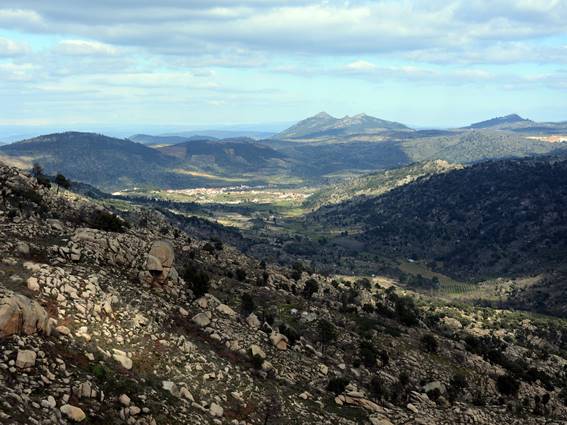
Fig. 01. View of
Trás-os-Montes (Portugal).
The river
valley —monumental and sublime, in the sense so well defined by Schiller (for
those capable of aesthetic emotion before the chance creations of nature)— [2] establishes rupture, discontinuity,
and the improbability of any connection with Spain (Fig. 02).
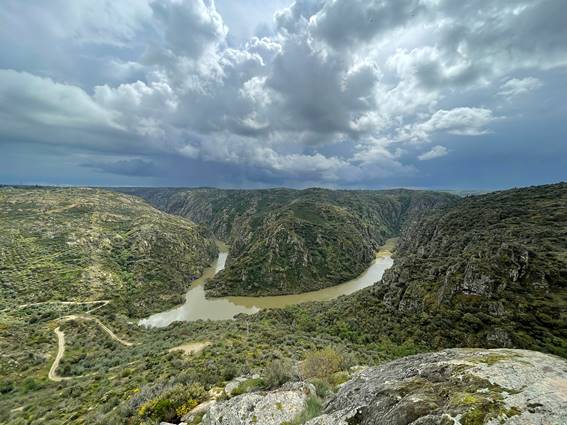
Fig. 02. View of
Fraga do Pulo (Portugal).
As a
result, the destination is the landscape itself: isolated, solitary, and
perhaps for that reason, almost mystical. Above all, it is the experience of
being immersed in it and dominated by it that prevails.
To this
process of knowledge embodied through wandering in the landscape —established
as a canon in Goethe (Italian Journey), Humboldt (Kosmos), and
Chatwin (The Anatomy of Restlessness)— architects add, through drawing,
a method of reading and transforming territory that incorporates experience,
the senses, and their material expression into the process of ‘conquering’ a
place (the becoming of the project). From John Soane to Le Corbusier, this path
would take root in the Porto School of Fine Arts (EBAP) and become one of the
defining marks of Távora’s pedagogy. [3] Traversing the landscape thus
becomes the first act of thought and design, as António Machado (1912)
poetically expresses it: «Traveler, there is no path; the path is made by
walking.»
Perhaps
this was the first design challenge of the Picote Chapel: an anchor facility
within a settlement whose plan, design, and construction display a rare modern
coherence, conceived to support the building and operation of the dam of the
same name (1953–59). Confronted with the overwhelming weight of the landscape,
the architect responds with a construction that, through the very act of
placing the object, interrogates nature and the civilizational impact upon it.
It is thus an architectural proposition that does not hesitate to identify and
mark the site through an unequivocal founding gesture—both in its siting and in
the symbolism of its form — in resonance with the mythical dimension of that
isolation.
As Portugal
began to open itself to the world in the postwar period, the exposure to
modernity that Nunes de Almeida encountered in Hoddesdon when attending CIAM
VIII (1951) was far from inconsequential, as were his participation in the CIAM
Summer School in Venice (1952), his presence at CIAM IX in Dubrovnik (1956),
the journeys undertaken across Europe by Archer, Almeida, and Ramos [4] —even when these occurred
concurrently with or after the construction of the Picote Settlement (including
trips made in the context of their work on the Douro hydroelectric schemes)— [5] and the teachings of Lúcio Costa on
architecture and landscape during his visit to Portugal. [6]
This
gesture thus reveals itself as simultaneously ancient and radically modern,
shaped both by close engagement with local culture and by the formal ideas that
guided the practice of modern architecture.
Plan/Project
In
Portugal, an overwhelmingly agrarian country where only Lisbon and Porto
constituted urban centers with any significant industrial development, postwar
European modernization efforts were reflected in the First National Development
Plan, which promoted a process of accelerated industrialization. Within this
framework of investment, the construction of power plants, communications
infrastructure, and transportation networks became a priority, entailing
decentralization and the creation of employment in territories long marked by
poverty and widespread industrial underdevelopment.
The shift
was abrupt in terms of both investment and economic impact—on a scale never
before experienced in the country—particularly in the International Douro, a
remote region whose productive conditions were closer to the eighteenth century
than to the twentieth. The new settlements of Picote (1954–57), Miranda
(1956–61), and Bemposta (1956–64), built to accommodate teams of engineers,
unskilled workers, and their families, are the result of this investment.
Its
construction coincided with the opening toward the canons of modern
architecture, already widely embraced in Europe as the appropriate response to
the challenges of postwar reconstruction and endorsed by Portuguese architects
since the First Congress of Portuguese Architecture (1948), as an alternative
to the conservative models promoted by the Estado Novo regime.
For this
reason, it was possible to invest in a modern approach not only in the
construction of the dams —necessarily modern due to their technical nature— but
also in the planning and architecture of the settlements. [7]
The fact
that the urban planning and architectural design were entrusted to three
recently graduated young architects is striking, yet fully consistent with this
commitment to innovation (Fig. 03).
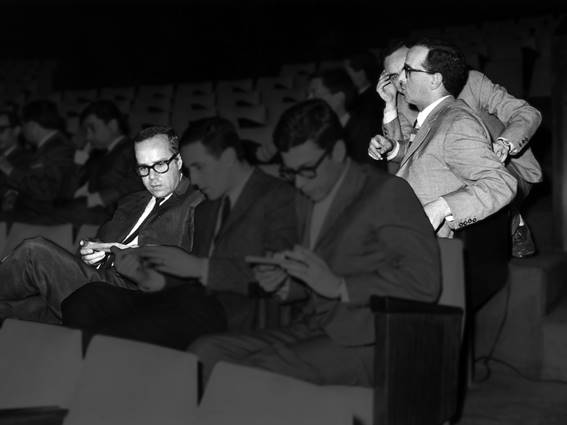
Fig. 03. João Archer de Carvalho, Manuel Nunes de Almeida, and Rogério Ramos, c. 1950.
Whether
this modernity was embraced for its constructive efficiency (economy and speed
of construction), for its capacity to attract specialized staff arriving from
the city and demanding levels of comfort previously absent in the area, or for
the persuasive force of the comparable models supplied by the engineering
consultants involved in the works, the fact remains that all the settlements
are anchored in a somewhat displaced garden-city imaginary, and their buildings
adopt a modernist matrix of unusual and vibrant intensity.
The
commission for the infrastructural development of the International Douro,
entrusted to young architects still untouched by the doubts that the early
fieldwork findings of the Inquérito (survey) [8] would later introduce into design
practice, thus became an opportunity to materialize —almost as in a laboratory—
the dream of modernity encountered in Europe. To construct a modern campus in
the midst of the countryside, in open and unrestrained dialogue with the
landscape and in deliberate counterpoint to the austerity (and poverty) of the
place. The rupture with the landscape, the productive fabric, and local culture
is abrupt; yet the appeal is irresistible, and the site —remote and
‘invisible’— proved ideal for such an experiment.
Yet in
Picote we do not find a city plan, because the relationships generated by the
architecture there do not operate primarily on a social plane; rather, the
project seeks to construct a place inscribed by the landscape, where the
fundamental tensions are those between human and nature, or human and God.
The
principal buildings (the chapel, the pousada, and the engineers’ houses)
appear isolated within the territory, their forms cut against the landscape
they seem to survey, like objects placed without any clear definition of
ownership. Within the overall settlement, however, they emerge only subtly,
partially concealed by topography and vegetation and revealed gradually along
the curves of the road that traverses the site. Descending toward the dam and
entirely invisible to those arriving, lie the service buildings (market and
school) and the housing for skilled workers (Fig. 04).
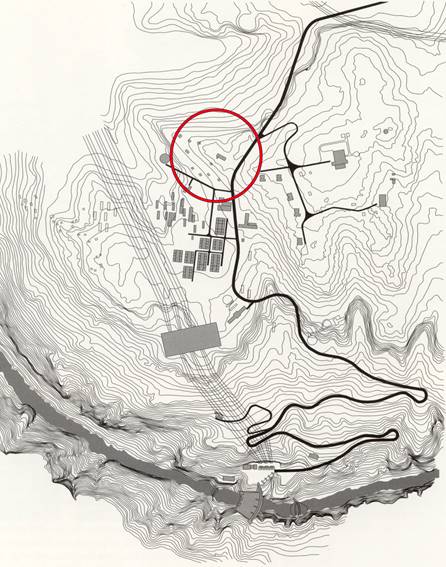
Fig. 04. João Archer de Carvalho, Manuel Nunes de Almeida, and Rogério Ramos, Picote Plan, 1953-59.
At the end
of the route —and the very raison d’être of the entire enterprise—
stands the concrete dam, a technological exhibition in itself in direct
confrontation with the river valley. These are isolated forms engaged in a
self-referential dialogue, akin to what occurs in the precincts of
international exhibitions where technological and artistic innovations are
displayed.
There is no
center, nor do the programs of collective or civic use that might have
generated one converge through an implantation strategy capable of producing
urban coherence: the Chapel, the school, the commercial center, and the pousada
are distant from one another, lacking both physical proximity and even visual
connection. Each building stands on its own terms, only occasionally
establishing relationships of adjacency —most notably between the housing for
skilled workers and the nearby commercial center.
Indeed, the
urban design appears primarily concerned with articulating the relationship
between architecture and landscape, aligning more closely with Defoe’s notion
of place-making for humankind than with Rousseau’s. [9] This almost dreamlike yet
progressive vision of a return to a more primitive human condition may also
explain the unequivocal symbolic investment in the design of the chapel, the
pousada, the engineers’ houses, as well as in the gardens and paths shaped in
dialogue with the site’s topography and landscape.
Beyond the
chapel, which will be examined in detail below, the design of the pousada and
the engineers’ houses —the most architecturally significant buildings,
prominently sited at the highest point of the settlement— further reinforces
this absence of urbanity.
The pousada
(Rogério Ramos, 1954–58), ambitiously positioned at the summit like a
desacralized acropolis, imposes a ceremonial ascending route and invests
uncompromisingly in a modern architectural language that may be related to
Brazilian modernism or to the work of Gropius, among others. Beyond the
modernity of its interior spatial organization, the entire architectural
proposition is articulated through its relationship with the landscape, with no
concession to urban order. The exterior space, devoid of physical boundaries,
reinforces this reading, as it is structured through carefully designed paths
aligned with the topography, with ‘no other destination’ than wandering through
the landscape (Fig. 05).
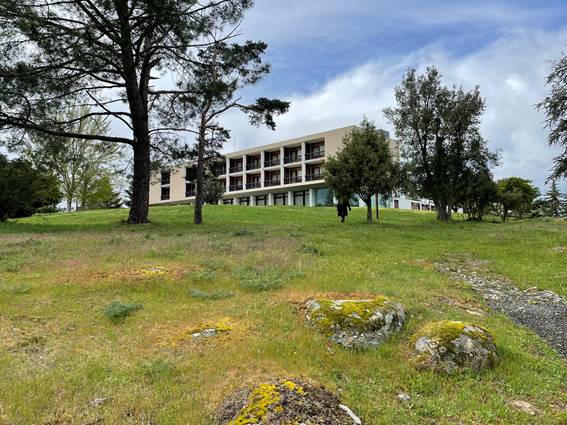
Fig. 05. Rogério Ramos, Pousada, Picote (Portugal), 1954–58.
The houses,
similar to one another, are freely arranged across the territory, with no
identifiable property boundaries; they appear as objects placed upon the
ground, extending themselves into the terrain through the social spaces (living
rooms).
Radical and
iconic, they emerge without physical or visual proximity to one another; they
are at once delicate and dominant. Architecture is present to guide the steps
of modern humanity in its return to the landscape, as a sign of conquest and,
simultaneously, as a support for something that lies beyond human relations. In
this sense, the ensemble proposes a connection to the spirituality of the
place, as well as to the theological dimension of human existence.
Chapel
In line
with the strategy for the settlement’s urban plan, the Chapel (1953–59) —a key
anchor facility intended to ensure social order at the time— is, not
incidentally, the first building visible from a distance and one of the
principal symbolic representations of the settlement; it is also the ensemble’s
finest architectural work. Nunes de Almeida (1924–2014) was twenty-nine years
old when he joined the team and began the project (Fig. 06).
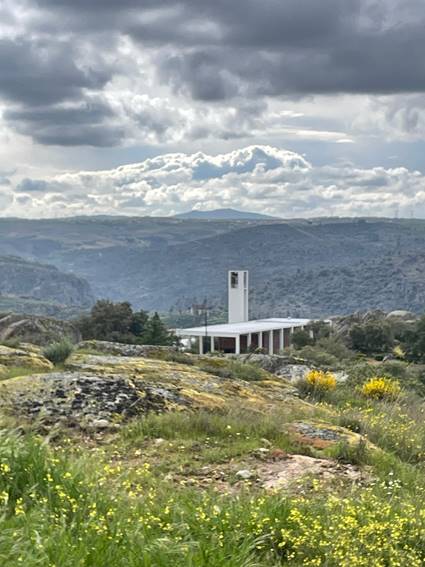
Fig. 06. Manuel
Nunes de Almeida, Chapel of Our Lady of Fátima, Picote (Portugal), 1956–59.
As
previously noted, the building’s siting does not follow any principle of
urbanity: it is not placed at the center of the settlement, nor does it
generate a public space adjoining the churchyard, as was traditional in parish
churches. On the contrary, although it is not located at the highest point in
the terrain, it is sited in isolation like a sanctuary, enacting a founding
gesture of a mythical time and temple that inevitably casts the visitor in the role
of a pilgrim. In this case, the journey and the way the building appears within
the landscape are more important than consolidating the community around it, or
even respecting the canonical eastward orientation, which it deliberately
disregards.
Significantly,
along the approach, the contrast between the open space of human —nature
celebration and the enclosed space for human— God communion is immediately
evident. The path thus evokes religious sensibilities ranging from pantheism to
an intimate connection with the divine. It may be here that the Picote chapel
finds its meaning and its unexpected innovation: the absence of physical
boundaries outside reinforces its centrality and dialogue with the landscape,
while the complete enclosure inside, adorned with Christian iconography,
directs attention toward prayer (Fig. 07).
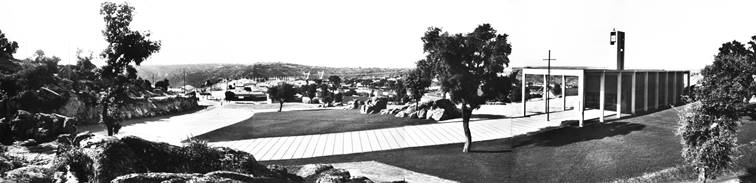
Fig. 07. Manuel
Nunes de Almeida, Chapel of Our Lady of Fátima, Picote (Portugal), 1956–59;
view in 1958.
The
liturgical paradox is both challenging and intriguing.
The concept
and formal strategy we refer to are therefore at once ancient and radically
modern: the regular, white-painted portico and the lateral tower appear cut
against the blue sky and the natural landscape, asserting themselves as a
monument. From the road, this composition sequentially shelters, along an axial
progression, the churchyard, the narthex, the nave/altar, and the sacristy, in
a design that inevitably recalls the rectangular arrangement of classical
portico and peristyle, accommodating the pronaos, cella, and opisthodomus —a
spatial structure we are accustomed to seeing empty, articulated only through
the rhythm of its columns (Fig. 08).
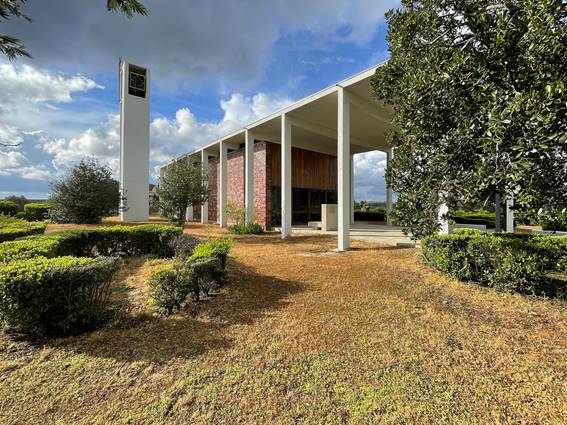
Fig. 08. Manuel
Nunes de Almeida, Chapel of Our Lady of Fátima, Picote (Portugal), 1956–59.
This
apparent tension between modernity and tradition is resolved through a dialogue
that seeks to bridge the two, a concern that would dominate architectural
debate in the following decade but is not unfamiliar to a young architect whose
training had been shaped at the Porto School of Fine Arts (EBAP), an
institution undergoing modern renewal yet still structurally dominated by
classicism. Nunes de Almeida also drew upon the ongoing European renewal of
religious practices, symbols, and spaces, which in Portugal was promoted by a
group of architects around the MRAR (1952–66), [10] anticipating the liturgical reform
that would result from the Second Vatican Council (1962–65). This was a
reformist movement in religious art that sought to break with excessive
academicism, valorize authenticity and symbolic meaning, and integrate
contemporary architecture, painting, and sculpture into religious spaces.
The
building is thus simultaneously unexpectedly modern and structurally classical,
embodying a relationship between tradition and modernity that extends into the
principle of a ‘total work of art,’ integrating architecture, furniture, sacred
art, and liturgical vestments (Fig. 09-10). The statuary by Barata Feyo, the
liturgical furnishings by architect Pádua Ramos, and the vestments designed by
architect Archer (executed by his sister) are therefore an inseparable part of
the building.
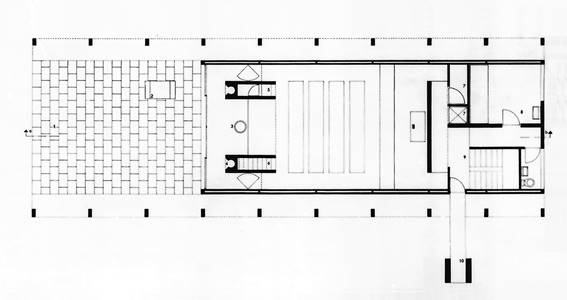
Fig. 09. Manuel Nunes de Almeida, Chapel of Our Lady of Fátima, Picote (Portugal), 1956–59; plan design drawing.
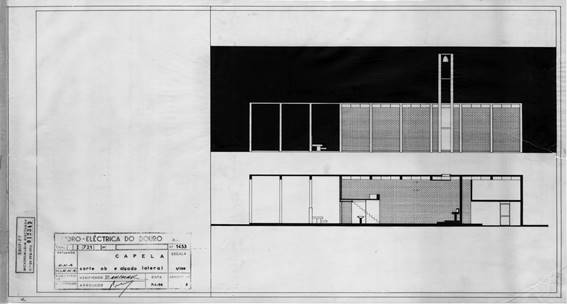
Fig. 10. Manuel
Nunes de Almeida, Chapel of Our Lady of Fátima, Picote (Portugal), 1956–59;
elevation design drawing.
From the
road, access is achieved along a long concrete paved path, creating a
processional route as wide as the chapel’s nave (Fig. 11). At the meeting point
with the covered churchyard preceding the entrance —a loggia open on three
sides— a granite base of the same width forms a step, emphasizing the space as
an exterior altar. In this context, the space is punctuated by a lectern in the
same material, placed to the left, suggesting use for religious ceremonies
during summer festivals (as in Le Corbusier’s Notre-Dame du Haut, 1953–55) or
for individual devotion when the chapel is closed.
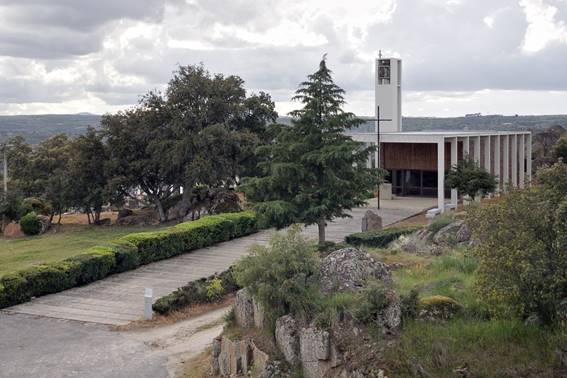
Fig. 11. Manuel
Nunes de Almeida, Chapel of Our Lady of Fátima, Picote (Portugal), 1956–59.
This is the
loggia found in Italian urban culture, but also, significantly, in the
religious buildings of Asplund and Lewerentz at the Woodland Cemetery in
Stockholm (1914–40) (Fig. 12). [11] It is a space that both
accommodates and marks the transition to the interior; a space of preparation
and deceleration that invites contemplation and inward reflection.
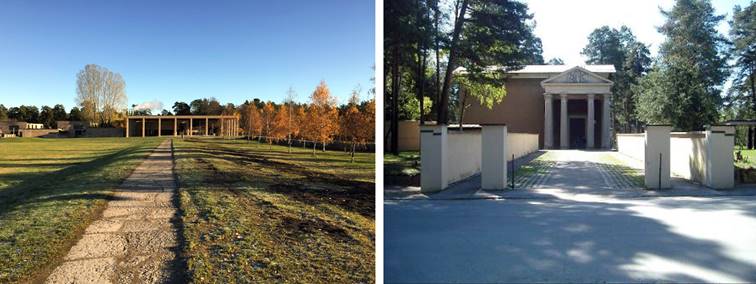
Fig. 12.
Chapel of the Holy Cross (Erik Gunnar Asplund) and Chapel of the Resurrection
(Sigurd Lewerentz), Woodland Cemetery, Stockholm (Sweden), 1915-40.
This first
space is framed by the main façade of the nave, glassed-in at eye level across
the full width of the volume enclosing the chapel. Its transparency emphasizes
the continuity of the spaces and invites both entry and prayer. However, once
inside the chapel, the lofted choir ceiling, along with the two supporting structures
that house the staircase and the confessional/holy water font, creates a
transitional interior–exterior space — lower, darker, and denser —before
revealing the altar, completely unobstructed and of double height (Fig. 13).
The nave thus appears larger, brighter, and taller after this passage.
Continuous light, flowing from the roof slab through the gaps between the beams
and brick walls, and especially through the skylight above the altar,
reinforces this sense of verticality (Fig. 14).
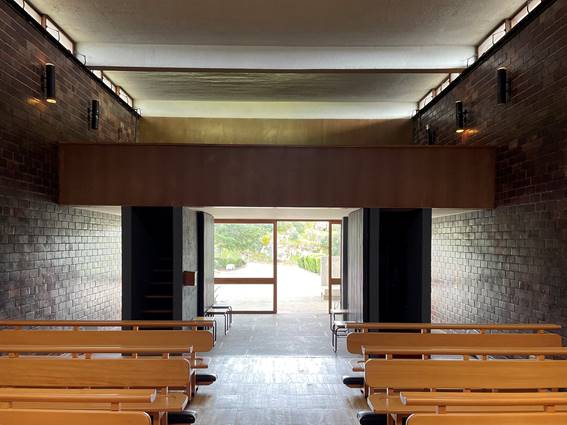
Fig. 13. Manuel Nunes de Almeida, Chapel of Our Lady of Fátima, Picote (Portugal), 1956–59; entrance and choir.
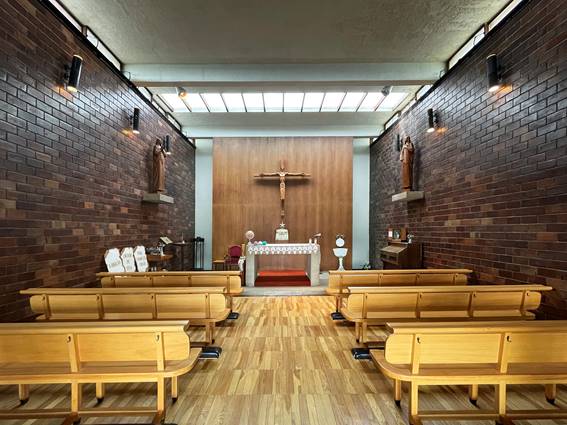
Fig. 14.
Manuel Nunes de Almeida, Chapel of Our Lady of Fátima, Picote (Portugal),
1956–59; nave and altar.
Behind the
altar, with separate lateral access from the exterior, are the sacristy and, on
the first floor, the catechism room.
The clarity
of the design, self-evident in its rigor and geometric logic, reveals both
maturity in the mastery of form and meaning, and a deep understanding of
contemporary architecture, as previously noted. It is therefore unsurprising
that the spatial sequence and the nave, terminated by the wooden wall defining
the altar (like a curtain), bear points of contact with Mies van der Rohe’s St
Saviour Chapel at the IIT in Chicago (1949–52). This resemblance is also
evident in the austere monumentality, symmetry, and the configuration of the
nave and the presbytery, with the altar positioned in exactly the same
location; it is further reflected in the arrangement of support spaces (behind
the altar), the materiality of the brick walls (interior and exterior), and the
roofing system (Fig. 15-16). [12]
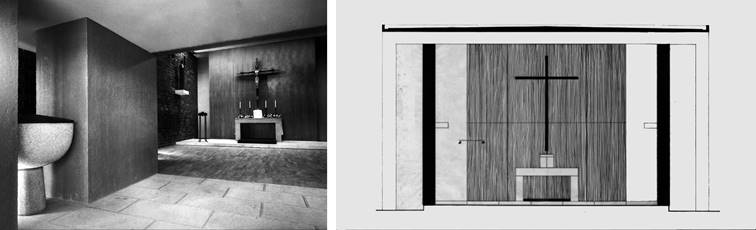
Fig. 15. Manuel Nunes de Almeida, Chapel of Our Lady of Fátima, Picote (Portugal), 1956–59; nave and design drawings.
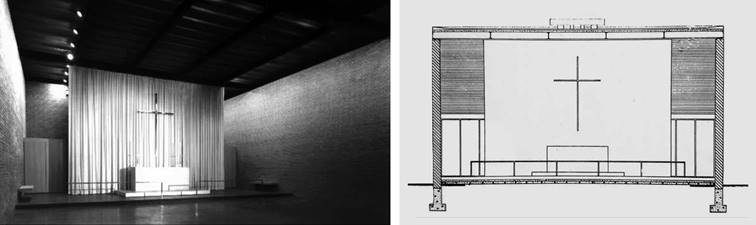
Fig. 16.
Ludwig Mies van der Rohe, St. Savior Chapel, IIT, Chicago (USA), 1949-52; nave
and design drawings.
Six years
elapsed between the start of the project and its consecration, which took place
on April 19, 1959. During this period, the project underwent some minor
adjustments, yet it essentially maintained its formal and symbolic cohesion, a
consistency that reflects the author’s conviction in the concept and
determination. Small modifications can be identified in preliminary drawings:
the bell tower was relocated from the right to the left side of the chapel,
along with its associated service access. This change opens an unobstructed
view of the entire portico for those arriving at the settlement and brings the
tower closer to the cluster of houses. Inside, the welcoming space is
reconsidered, with the design of the confessional altered to incorporate the baptismal
font — initially positioned at the centre — within its structure. The granite
altar, originally placed against the wooden wall, was later moved forward,
allowing the priest to face the congregation. There are no exact dates for this
transformation; however, its original position can be identified in the project
drawings and in the earliest photographs of the chapel, while its relocation is
already evident in the 1960s, most likely after 1965.
Preservation
Radical,
iconic, and the finest building of the Picote ensemble, the chapel first gained
public visibility at the MRAR Exhibition at the Paço Episcopal do Porto
in June, 1959 and in the review in Colóquio. Revista de Artes e Letras,
no. 8, April 1960, although the coverage focused primarily on the design of the
works of art. Subsequently, perhaps coinciding with the critical reevaluation
of the modern movement, the chapel and the other buildings of Picote faded from
collective memory; only a solitary caretaker, aware of the chapel’s
particularity, maintained the space for years. In the 1990s, Picote re-emerged
through the work of architects Fátima Fernandes and Michele Cannatá in the
publication Moderno Escondido (1997), a work they continued through the
careful rehabilitation of some of the buildings, a process that continues
today, generating a renewed guide for discovery, curiosity, and the ‘necessity’
of visiting the place (Fernandes 2015).
Sixty-five
years after its construction, Picote continues to reveal its unexpected
novelty: an architecture emerging anew, awaiting (re)use after years of
abandonment, neglect, and above all the lack of a sustained purpose in a
national investment project that failed to consolidate human occupation in this
territory.
The
importance of preserving a group of such high-quality buildings, which so
clearly reflect the political and cultural paradoxes of the period in which
they were built, is unequivocal. Picote has embedded itself in our memory as a
sign of modernity — a rare moment of cohesion between planning, design, and
construction, preserved to this day as if in a time capsule, a mythical place
of modernity.
Even in
disuse, the relationship of the building with the site, in an almost
eschatological sense of the sublime, remains a powerful mediator between the
physical world and what lies beyond it. Perhaps it offers a clue toward the
necessary revision of religious practices, so often detached today from
contemporary life and experience.
Bibliography
Barreto, Costa. 1960. «Uma exposição de Arte Sacra Moderna no Porto, Lisboa». Colóquio. Revista de Artes e Letras 8: 12-15.
Fernandes, Fátima. 2015. «A Arquitectura na Construção da Paisagem. Ferramentas e Princípios dos Projetos do Douro Internacional (1953-1964)». PHD dissertation. Polytechnic University of Madrid.
Fernandes, Fátima and Michele Cannatà. 1997. Moderno Escondido: Arquitectura das Centrais Hidroeléctricas do Douro 1953-1964. Picote, Miranda, Bemposta. Porto: FAUP Publicações.
Vasco Ferreira, Pedro. 2007. «La Capilla de Picote». Actas de Arquitectura Religiosa Contemporánea 1: 258-265. https://doi.org/10.17979/aarc.2007.1.0.5029
Machado, António. 1912. Proverbios y cantares. Campos de Castilla. Sevilla: Renacimiento.
Schiller, Friedrich. (1793) 2017. The Sublime. Madrid: Casimiro.
Tostões, Ana. 1997. Arquitetura Moderna Portuguesa 1920–1970. Lisboa: IPPAR.
Universidade do Porto. 2025. «Antigos estudantes ilustres da Universidade do Porto: Nunes de Almeida». Sigarra.up.pt. https://tinyurl.com/4akmyn9y
Vieira Ferreira, Manuel. 2007. «La renovación de la arquitectura religiosa en Portugal durante el siglo XX». Actas de Arquitectura Religiosa Contemporánea 1: 250-257. https://doi.org/10.17979/aarc.2007.1.0.5028
Credits
Fig. 01, 11.
Jorge Carvalho, 2025.
Fig. 02, 05-06,
08, 13-14. Author, 2025.
Fig. 03, 07, 09-10, 15. Fátima Fernandes Archive.
Fig. 04. Drawing by Fátima Fernandes (Fátima Fernandes Archive).
Fig. 12. Author, 2007.
Fig. 16.
Wikiarquitectura.com.
Notes
[1] Manuel
Carlos Duarte Nunes de Almeida was born in Porto. He enrolled at the School of
Fine Arts of Porto in 1945 and received his Diploma in Architecture in March
1958.
[2] For Schiller
(1793), the sublime reveals the dignity of man: even when subject to the forces
of nature, he remains free in spirit.
[3] One of
Álvaro Siza’s guiding principles is the idea that a project is born more from
the ‘place’ than from the architect’s mind—a principle that the Porto School
would later distill into the phrase: the project is in the site.
[4] Authors of
the plan and buildings of the Picote ensemble, a support settlement for the
construction and operation of the Picote Dam (1954–57). Among other references,
see the journeys undertaken in the context of work on the Douro hydroelectric
scheme (Fernandes 2015).
[5] The journey as a research tool was highlighted
by Carlos Ramos in the curricular renewal at EBAP and would become one of the
defining hallmarks of Távora’s pedagogy.
[6] Featured in
the exhibition of Brazilian modern architecture at the III Congress of the UIA
in Lisbon (1953) and published in Arquitetura 53 (December 1954).
[7] The urgency
of housing 5,000 workers likely justified the pragmatic, construction-site
approach, with standardized typologies and series production for the
prefabricated wooden houses and dormitories.
[8] Survey of
Portuguese Popular Architecture, 1955–61, with a team led in
Trás-os-Montes by Octávio Lixa Filgueiras.
[9] See the
relationship between Daniel Defoe’s concept of the ‘civilized man’ and
Jean-Jacques Rousseau’s ‘natural man’.
[10] Religious
Art Renewal Movement, 1952–66. This group of architects included, for example,
Nuno Teotónio Pereira and Nuno Portas.
[11] Although
Brazilian modern architecture was already known in Portugal and may have
influenced the design of the pousada (Niemeyer’s Pampulha Art Museum), in the
case of the chapel, the design of the Palácio do Planalto in Brasília—which
bears evident formal similarities—was created at the same time and therefore does
not appear to be a likely reference.
[12] The project
was published in the 1950s by L’Architecture d’Aujourd’hui. Another
point of proximity to Mies van der Rohe can also be observed in its conceptual
relationship to the portico of the Farnsworth House (1946–50), the covered
atrium, and the use of a white structural frame.