The Symbolism of a Modern Church Space Composed with
Light
The Case Study of Hodász Catholic Church
Construction from the Bottom Up (1971-77)
El simbolismo de un espacio eclesial moderno compuesto con luz. El caso de la construcción de la iglesia católica de Hodász desde la base (1971-77)
Zorán
Vukoszávlyev · BUTE-Budapest University of Technology and Economics (Hungary) ·
zoran.vukoszavlyev@gmail.com · https://orcid.org/0000-0002-6213-7227
Recibido: 06/04/2026
Aceptado: 03/06/2026
ABSTRACT
Architect
László Csaba (1924-95) built churches during a period of political repression –
the modern works provoked opposition from the church communities, while they
received professional acclaim (the latter being internationally renowned). St
Paul church in Hodász was built with the participation of the members of the
community thanks to the simpler construction techniques commonly used in the era.
Using documents preserved by the architect’s heirs, such as plans, written
documents and the architect’s own photographs, the presentation reveals the
creation of the church, built during the period of state-controlled
ecclesiastical activity. The struggle and ingenuity of an architect who was
always committed to modern architectural design are revealed in the creative
will of a small community that wanted to build despite the atheist political
power. Through the story of the church in Hodász, designed and built between
1971-76, we see a clearer acceptance of modern architecture at both
ecclesiastical and secular levels – in a very specific religious environment.
The abstract modern space, created with a symbolic composition of light and
high quality artwork, still bears the memory of its era.
Keywords
Hungary,
László Csaba, light, longitudinal plan, modernity
Resumen
El arquitecto László Csaba (1924-95) construyó iglesias durante un periodo de represión política. Sus obras modernas suscitaron la oposición de las comunidades eclesiásticas, si bien recibieron reconocimiento profesional (este último a nivel internacional). La iglesia de San Pablo en Hodász fue construida con la participación de los miembros de la comunidad gracias a las técnicas de construcción más sencillas propias de la época. Utilizando documentos conservados por los herederos del arquitecto, como planos, escritos y fotografías del propio arquitecto, la presentación revela la creación de la iglesia, construida durante el período de actividad eclesiástica controlada por el Estado. La lucha y el ingenio de un arquitecto siempre comprometido con el diseño arquitectónico moderno se manifiestan en la voluntad creativa de una pequeña comunidad que deseaba construir a pesar del poder político ateo. A través de la historia de la iglesia de Hodász, diseñada y construida entre 1971 y 1976, observamos una mayor aceptación de la arquitectura moderna tanto a nivel eclesiástico como secular, en un entorno religioso muy particular. El espacio moderno y abstracto, creado con una composición simbólica de luz y obras de arte de alta calidad, aún conserva la memoria de su época.
PALABRAS CLAVE
Hungría, László Csaba, luz, planta longitudinal, modernidad
*
Modern
architecture has its own unique characteristics associated with the great
periods of 20th century history. Modernisation created a changing economic
environment, which resulted in technical and intellectual innovation, and
social changes led to a new worldview. The renewal movements of the Christian churches
were closely linked to modern architectural aesthetics: it became a feature of
the progressive movements between the two world wars, and in the second half of
the 20th century it was used in almost direct continuity by the Catholic
Church, which was renewed in the spirit of the Second Vatican Council
(Fernández-Cobián 2005; Fernández-Cobián 2006; Della Longa 2007; Zahner 2007;
Longhi 2018). During the 1950s, however, significant political changes took
place in Eastern Europe: the Church was shaken in its foundations, and a return
to tradition was a way of resisting drastic changes.
In the
anti-clerical environment, churches could only be built in exceptional cases
(for example, if a sacred site was demolished or destroyed by other state
construction). At the same time, state contributions were small, the church
that built the church had to face a shortage of building materials, and the
bureaucracy also created obstacles to the construction – for example, the use
of tower shapes was prohibited (Lantos 2009; Urbán and Vukoszávlyev 2016).
However, amidst all the hardships, the construction of the church became an act
of community unity: the use of local materials and the contribution of local
manual labourers built a church in Cserépváralja, a small rural village very
far from the centre of state power. But confidence in the process was shattered
when the faithful had been confronted with the modern creation. (Kovács and
Vukoszávlyev 2025) (The architect had adapted his expressive modern vision to
the possibilities offered by the vernacular tradition – and indeed risked his
own career by participating in the church’s construction.)
But it was
no different with the church in Hollóháza, which was built a few years later.
Although the community of believers working in the village’s modern state-owned
factory was more open to the new design, and the architect was able to work
under better conditions, with high-quality construction supported by the state,
they still could not identify with the highly abstract geometrical composition
(Lantos 2015).
By the
mid-1960s, the conflict between the State and the Catholic Church had reached a
compromise, a process characterized by a structured framework – though
certainly not free of compromises – (which was primarily reflected in the
state’s supervisory role). In line with the agreement that became official,
spectacular results emerged in a form that could be communicated to
international platforms, clearly identifiable through contemporary
architectural solutions. The church supported the creation of these modern
works, but they still provoked opposition from church communities, while at the
same time receiving recognition in professional circles (the latter being an
internationally renowned work). [1]
It was only
around this time, at the end of the 1960s, that the atheistic political
oppression began to ease (Vukoszávlyev and Urbán 2016; Lantos 2018). Parallel
to the ongoing process of church renewal, the construction of church buildings
created through collective cooperation became somehow compatible with the
worldview of Hungary’s modernizing society, now uniformly in the late modern
style supported by cultural policy.
The
designer of these works, architect László Csaba (1924-95), was committed to
modern architectural design, characterized by conceptual compositions that
modulate interior spaces using natural light: the space, which is clearly
directed from the entrance, the layout rising towards the altar, and the
dramatic use of immaterial light as a building material all support spiritual
focus (Vukoszávlyev 2017). This generous composition is also evident in the
Church of St. Paul in Hodász, which will be described in detail below and
which, thanks to the simplified construction techniques commonly used at the
time, was built together with members of the community.
Drawing on
documents preserved by the architect’s heirs and utilizing the plans and
written memoirs found in the private archive —which has been organized in
recent years— [2]
this study traces the construction of the church, built during a period when
church operations were controlled by the state, a narrative fully illustrated
by photographs taken by the architect himself. The study also examines the
relationship between the architect and his client, the processes of acceptance
of contemporary ecclesiastical art, and evaluates the building’s place within
the contemporary international and national architectural context.
Hodász is a
small village located near the eastern border of the country in the Carpathian
Basin. The church was built in the center of this agricultural village, between
public buildings (town hall, post office, school). The construction was subject
to certain restrictions: according to a 1966 plan (by architect Pál Horváth),
the new parish house was built next to the street, and the site for the church
was created inside the plot by demolishing a converted farm building behind it,
which had been used as a temporary chapel (Fig. 01). Within the modest
financial constraints of the diocese, the new building was intended to
strengthen pastoral care – the priest counted on the cooperation of the
400-person community in its realisation. From the architect’s recollections, we
know how important the parish priest’s attitude was: Sándor Szabó, the
enthusiastic and understanding leader of the community, won over the entire
village not only for the construction, but also for understanding the
contemporary architectural message.
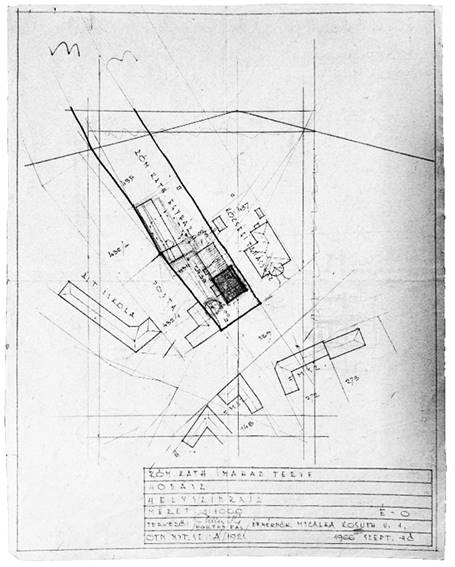
Fig. 01.
Hodász Catholic Church (Hungary); not realized site plan by Pál
Horváth, dated 1966.
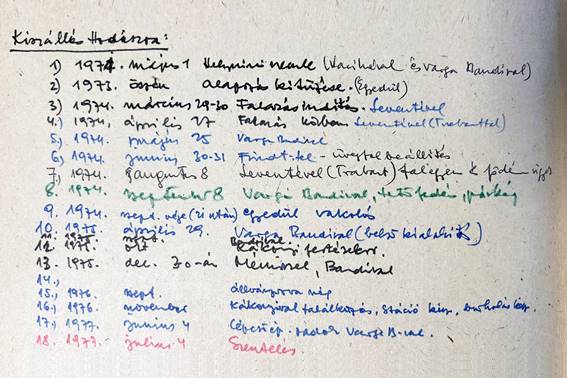
Fig. 02.
László Csaba, Hodász Catholic Church (Hungary), 1971-77; timeline
notes on construction phases.
László
Csaba, who had been politically compromised by his previous church designs,
received an invitation from the Diocese of Eger – with Archbishop Pál
Brezanóczy’s recommendation – in April 1971 to prepare sketches for a chapel.
A month and a half later, the architect was already conducting a site
inspection, but it was not until two years later that the permit application
was submitted. The plans, registered as those of a private designer, received a
building permit dated August 2, 1973. The foundations were laid in the fall,
and by the following spring, the walls began to rise. By fall of ‘74, the
building was under roof (Fig. 02).
During
1975, interior work progressed slowly. In October, the artist began work on the
altar wall secco, but the complete liturgical furnishings would not be ready
for another year. The church was probably consecrated at the end of June 1977
(according to a less credible engineering record, on Monday, July 4) by
Archbishop József Bánk of Eger (Fig. 03-06).
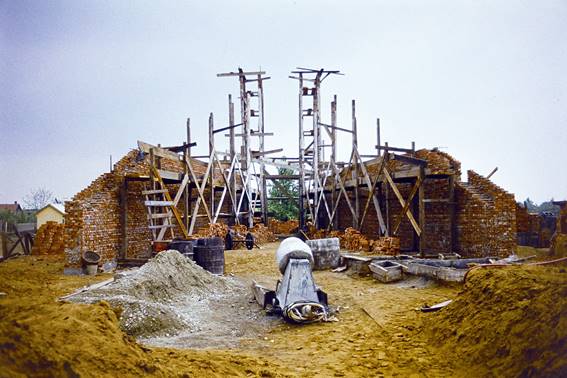
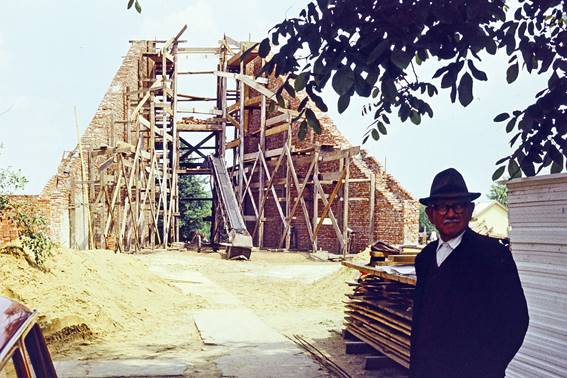
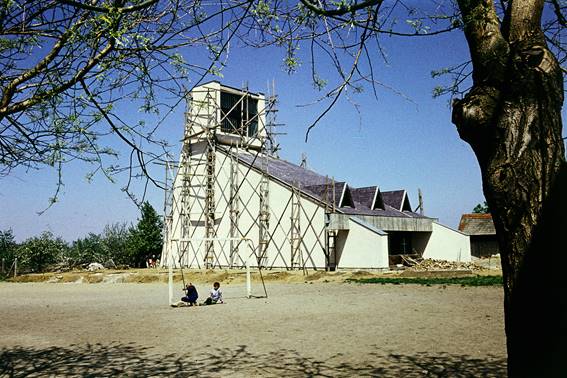
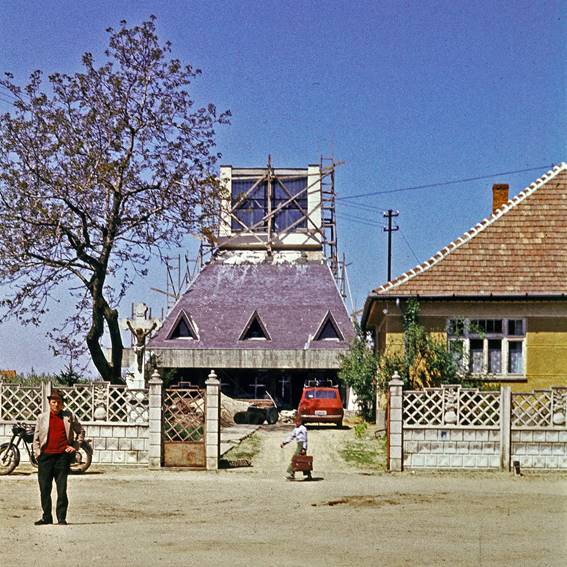
Fig. 03-06.
László Csaba, Hodász Catholic Church (Hungary), 1971-77; phases
of construction on images taken by the architect during site visits.
The first
sketches featured an organically shaped church interior enclosed by walls set
back into the plot. The designer depicted the process of passing along the
walls, beneath canopies and under low-height vestibules, as the dramaturgy of
preparation (Fig. 07-08). Upon entering the space, the designer organized the
space with dynamically unfolding, upward-breaking walls and a high ceiling,
highlighting the focal point of the liturgical space with light. The organic,
eccentric composition was combined with a solution bearing vernacular features,
a house growing out of the ground, and the unique placement of the altar under
the flowing light – all of which are characteristic features of the diagonal
spatial organization of liturgical spaces of the era.
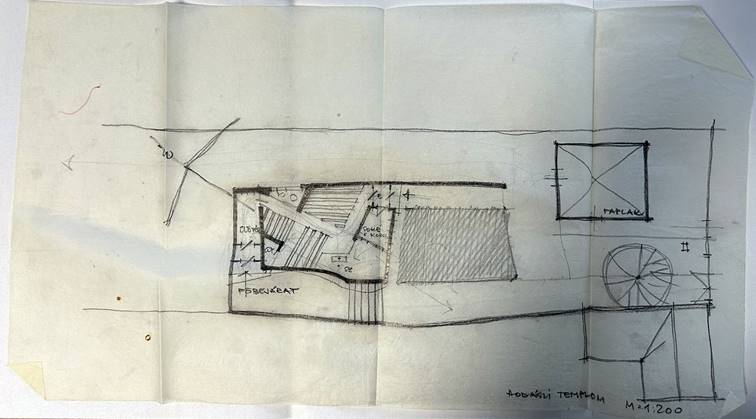
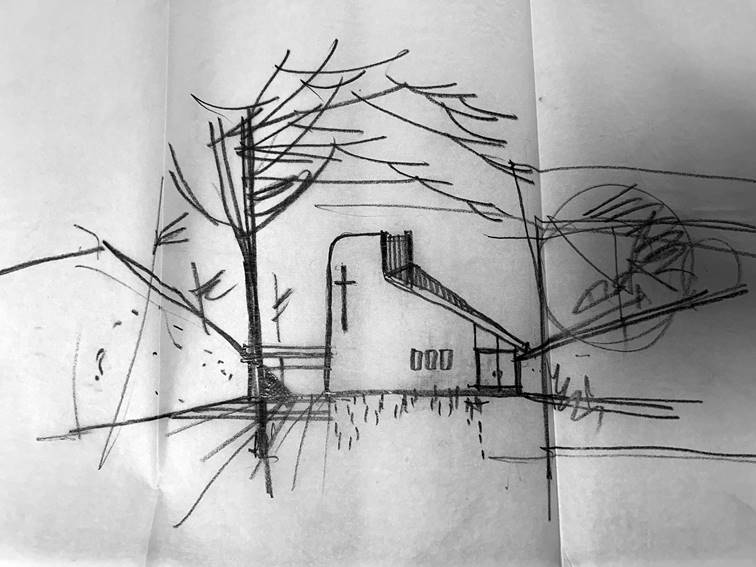
Fig. 07-08.
László Csaba, Hodász Catholic Church (Hungary), 1971-77; first
sketches dated 1971.
We are
witnessing a transformation of the plans for the coming year, but we are unable
to uncover the reasons for the changes due to a lack of documentation. (Only
the expert opinion of the engineers of the county planning company from August
1972 is known, which examines the soil at test points corresponding to the
geometry close to the new plans.) Based on the surviving drawings, we can
witness the development of a much more distinctive composition (Fig. 09-10).
The series of plans dated April 2, 1973, demonstrates an approach along a
direct axis, positioning a low and wide opening at the entrance and forming a
space that narrows slightly from the entrance towards the altar area, but is
directed by walls that rise very dynamically. The walls, which become parallel
at the altar, define a vertically elevated space, with the rear wall leaning
slightly inward, creating a light-filled space illuminated by a high lateral
glass wall. The mass composition, which honestly reveals the striking spatial
form, creates a monumental effect in the relatively small sacral building (25
meters long and 13 to 6 meters wide). The model photos clearly show the rawness
of the composition, which is counterbalanced by the low sacristy connected to
the transitional space and a bell tower remaining in the background (Fig. 11).
Based on the detailed geometric plans, construction could begin with the
official permit in hand – the series of plans provided precise solutions for
the details. With the plans approved, the construction was entrusted to the
expertise of local builders.
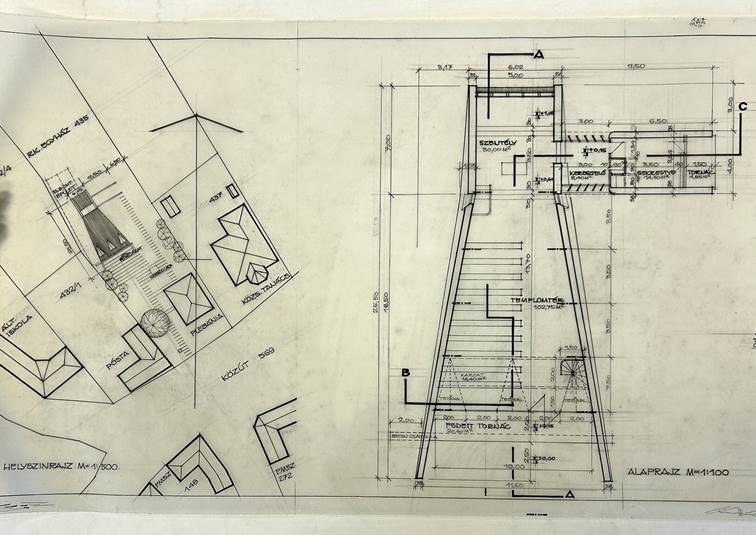
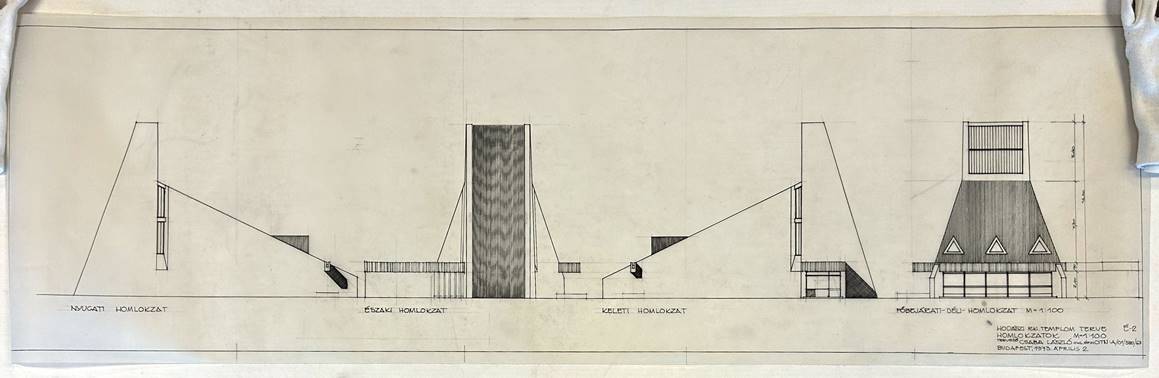
Fig. 9-10.
László Csaba, Hodász Catholic Church (Hungary), 1971-77; original
plans of the church for permission, dated April 1973.
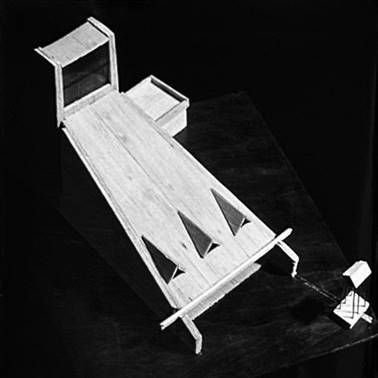
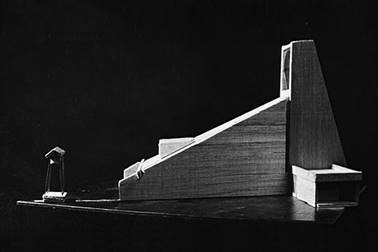
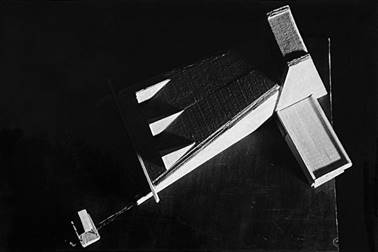
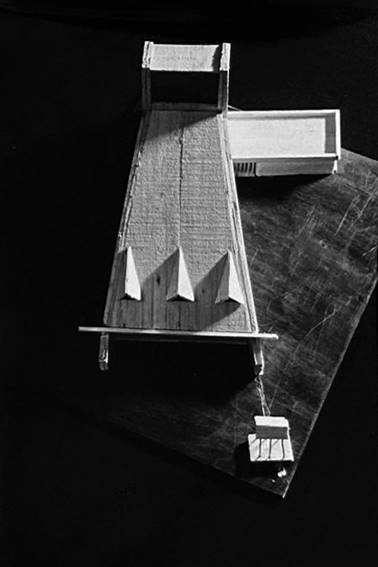
Fig. 11.
László Csaba, Hodász Catholic Church (Hungary), 1971-77; photos
of the model of the church (model preserved).
At the end
of March 1974, construction of the walls began. The small brick wall structure
with varying geometry, ranging from 50 cm to 1 meter in width, was built with
the devoted expertise of local and regional craftsmen. The designer and his
colleagues only visited the construction site once every month or month and a
half, which was far from the capital (appr. 300 kilometers away, which at that
time could only be covered by a 5-6-hour drive). Levente Thoma’s plans for
reinforced concrete structures date from May 1974 – with the help of community
members, the walls were already half-built by that time.
It is clear
that the work was in a difficult phase, and the detailed plans (floor slab, roof
drawing with windows, steel doors and windows, and the gallery stairs) were
probably only prepared on a scheduled basis for the less frequent site visits,
but their complete completion and documentation in a single package is unknown.
Their
technical content leaves nothing to be desired, but there are also clearly
work-in-progress and fully developed drawings in the plans accompanying this
construction phase (Fig. 12).
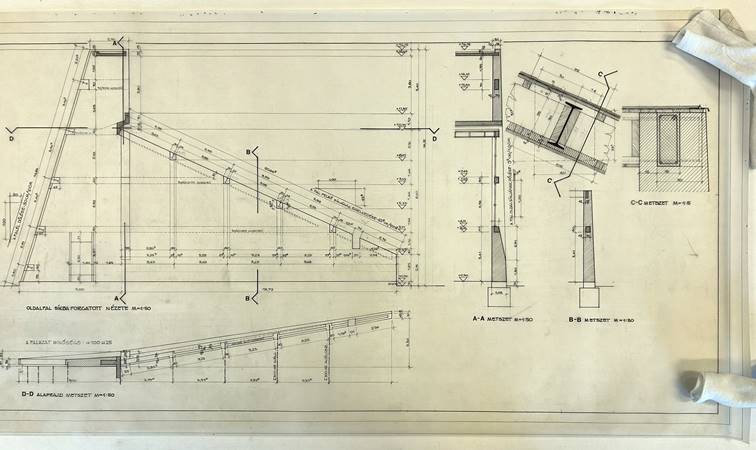
Fig. 12.
László Csaba, Hodász Catholic Church (Hungary), 1971-77; structural
plan without dating.
In his
memoirs, László Csaba speaks with great admiration of the dedication and native
knowledge of the workers involved in the construction process. The engineer
found himself in a good position of balance here. Given the scale of the
building, the solutions did not require particularly unique structures, and
everything was completed with the help of local craftsmen and in small-scale
methods (Fig. 13-14).
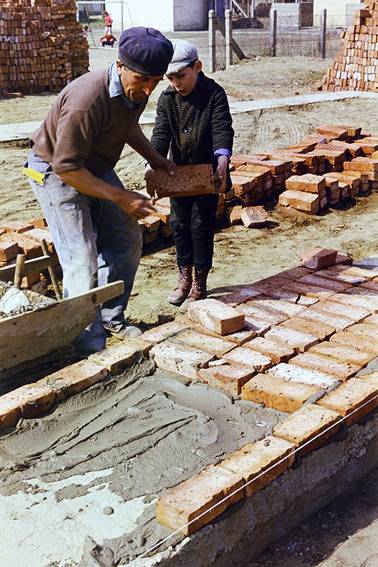
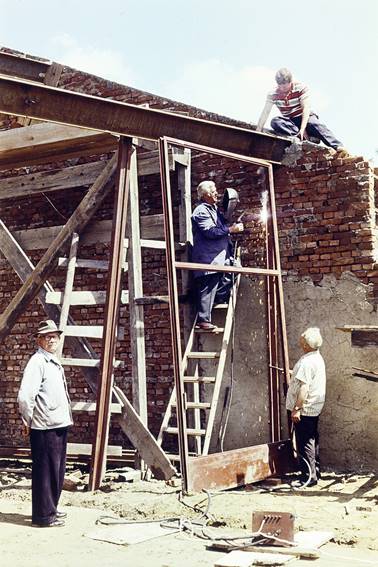
Fig. 13-14.
László Csaba, Hodász Catholic Church (Hungary), 1971-77; construction
phases with local craftsmen, images dated 1974.
At the same
time, the professional requirements could not have been met by the drawings and
the rare site visits alone, had it not been for an enthusiastic, all-engaging
parish priest who oversaw the construction and took the lead in the
organization. Sometimes resorting to reluctant pressure and, when necessary,
relying on the opinions of recognized individuals, he also exercised control
over the designer’s work.
The
pastor’s striving for perfection is also evident in correspondence concerning
the interior design. In the spring of 1975, Sándor Szabó engaged in lively
discussions with the designer and the artist he wanted to commission to paint
the altar wall. He sent the designer’s layout proposals, which were still only
in draft form at the time, to the Franciscan monk and painter Asztrik Kákonyi.
In doing so, he sought to position the sacred space at the highest level of
ecclesiastical art, while also ensuring the correctness of his decisions, which
were intended to determine the careful design of the liturgical furnishings and
the modern world of contemporary ecclesiastical symbolism. The monk-painter
assesses the architectural plans as follows: he considers it very important to
respect the creative freedom of the designer, as he sees the whole vision and
clearly wants to create something original in the interior as well. He
therefore recommends that the parish priest show great respect for the
architect’s ideas—while the pastor seeks practicality in the formulation of the
plans, the architect intends to shape them for the sake of the beauty and order
of the space. A functionality-based debate would have broken out between the
priest and the designer over the arrangement of the pews, but in the end, it
was much more important in the correspondence to develop the concept of wall
painting that reinforced the spatial concept and to define the symbolism in
harmony with the architecture.
Contemporary
clergymen relied heavily on the insights of the monk painter. Kákonyi, who
proclaimed modern liturgical art with faith and conveyed an expressive world in
his works, explains his insights step by step in relation to the design of the
altar’s back wall. He does not criticize the designer’s desire for an empty
composition featuring only a cross, but rather shapes his opinion in accordance
with the Liturgical Constitution, finding its main element, the representation
of the cross, and supports the symbolic use of a Crux gemmata depicted
in a mural. Kákonyi adds to the architect’s vision, which strives for a high
degree of abstraction, the idea that the cross has its place on the altar or on
the wall in a smaller size, as the dramatic use of the symbol is in accordance
with the story of St. Paul’s conversion through suffering.
Kákonyi
finally made sketch proposals for a 3x5.5-meter surface within the dimensions
specified by the architect, naturally in a cross-shaped composition. The
sketches preserved in the architect’s estate (although not dedicated, but
probably by the monk painter Kákonyi) highlight the figure of Christ appearing
in a shaft of light against a cross-shaped background, with Saul fallen to the
ground at his feet. Kákonyi emphasizes that the mural should start above human
height, and the composition will almost merge with the sunlight streaming in
through the high lantern (Fig. 15).
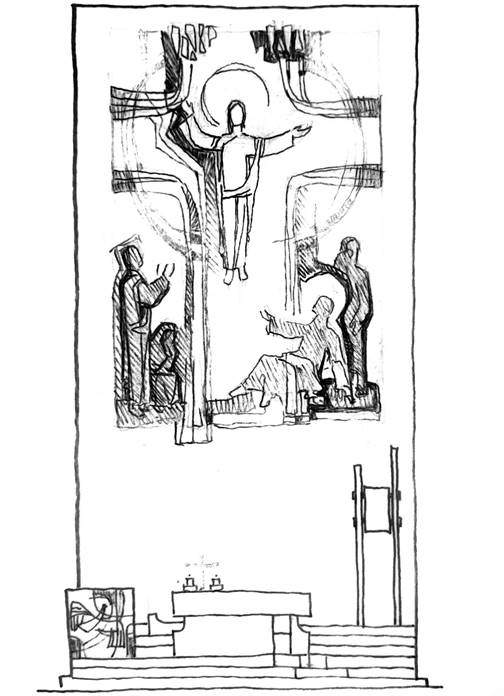
Fig. 15.
László Csaba, Hodász Catholic Church (Hungary), 1971-77; sketches on
altar design and wall painting by Asztrik Kákonyi, dated May 1975.
This effect
is also evident in the completed mural, but its formal composition is
different: the depictions of the saints rise high from the dark background,
with the figures of Saints Peter and Paul in the center, above them the teacher
Christ shining in a flood of light, holding an open Bible, surrounded by
archangels already transfigured in the light. During the interior construction
work, in May 1975, the parish priest sent the architect the results of his
discussions with the sacred artist. Although construction was well underway,
the plans were slow to be completed. According to the designer’s recollections,
Kákonyi had already begun plastering the secco that autumn, and it was already
November, a year later, when the liturgical furnishings and other works were
installed with the completion of the pavement. In its final form, the artwork
painted using the sgraffito technique covered the entire back wall of the
altar, measuring approximately 5 by 15 meters; it began with deeper tones at
the lower level and gradually lightened toward the top, creating a sense of
lightening as it rose, with a smooth transition beginning at a height of nearly
2 meters (Fig. 16).
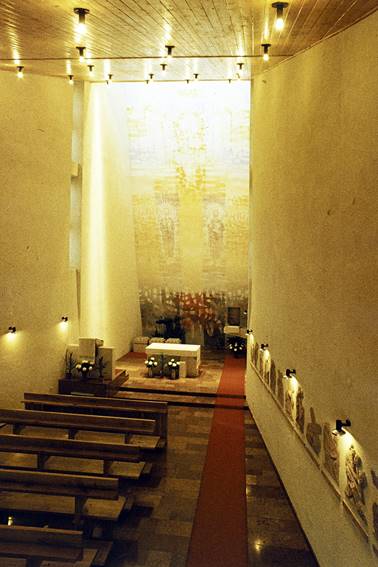
Fig. 16.
László Csaba, Hodász Catholic Church (Hungary), 1971-77; interior
of the church towards the altar, image dated 1977.
The design
of the tabernacle in the early plans was a closed block standing on pedestals
and appearing to float; in its final form, the tabernacle was placed on a
console protruding from the side wall of the altar. Its copper embossed door
depicts the scene of Paul’s conversion. Miklós Borsos’s work thus brought to
life the drama of conversion, with all the tension of that moment of commitment
(Fig. 17). The corbels on the right wall of the church feature Aurélia Németh’s
evocative series of 14 stations. No plans have survived for the block-like
liturgical furniture, but we can describe its design based on its actual
appearance: the altar table (mensa), the sedes, and the ambo are made of
marble. The pews are light-looking pieces of carpentry. At the entrance, the
steps of the deep, bridge-like gallery, which crosses the square, continue this
lightness (Fig. 18).
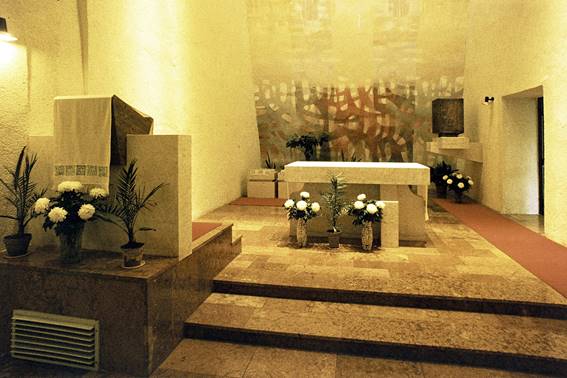
Fig. 17.
László Csaba, Hodász Catholic Church (Hungary), 1971-77; liturgical
equipment of the altarspace, image dated 1977.
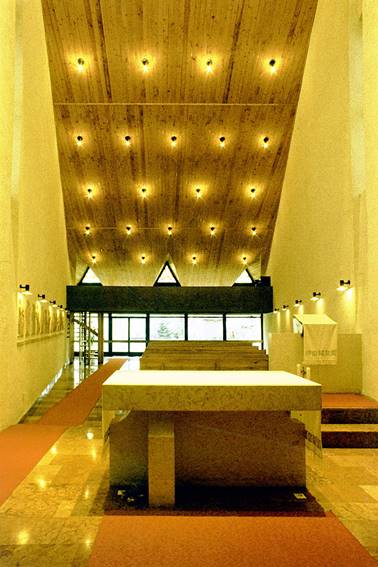
Fig. 18.
László Csaba, Hodász Catholic Church (Hungary), 1971-77; interior
of the church towards the entrance, image dated 1977.
In the
triangular skylights above the choir, colored glass breaks up the abstract
forms and colors of the space, while the colored glass windows in the
vertically split walls at the turning point of the sharply converging
composition somewhat contradict the perception of the light-controlled space.
The former feature biblical quotations in a freer composition, while the latter
feature Biblical and Hungarian (female and male) saints. High above the altar,
in a position hidden from the congregation, is a large skylight made of copilit
glass, with an stylized figurative representation of Christ on the cross in a
cross-shaped division (Fig. 19).
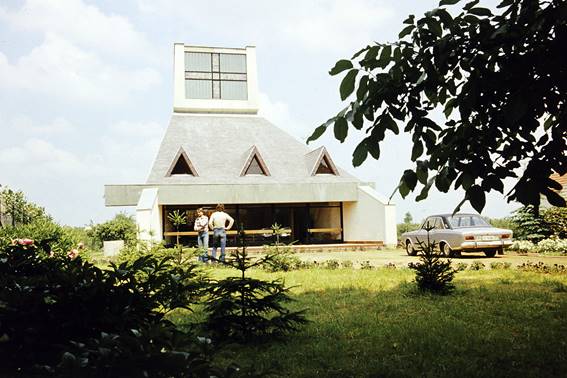
Fig. 19.
László Csaba, Hodász Catholic Church (Hungary), 1971-77; main
view of the church, image dated 1977.
«While the space narrows inwards in terms of floor plan, it rises
strongly upwards and opens up, while at the same time the illumination of the
space gradually decreases inwards, then in the line of the sanctuary its
illumination suddenly becomes powerful due to the light flowing in through the
hidden, large-sized skylight that is not visible from the nave» – describes the
architect the main principle of the architectural composition, the symbolic
spatial treatment of light (Csaba 1978). The formal approach emphasized by
László Csaba is characteristic of modern churches built in the second half of
the 20th century: rather than the use of direct visual elements, it is
characterized by more abstract forms and highlights the role of natural light
in defining the focal point of the liturgical space. The architectural
solutions of the Hodász church show no direct connections to the international
sacred buildings of the era, but the spatial verticality (St. Rita, Harelbeke,
1962, Arch. Léon Stynen), the space composition rising more gently toward the
altar area (Bruderklaus Church, Brüsfelden, 1959, Arch. Hermann Baur) or rising
dramatically (St. Thomas, Helmstedt, Braunschweig, 1963-67, Arch. Dirk-Erik
Kreuter and Ulrich Hausmann) reveal the symbolic system of spatial hierarchy.
The composition of natural light, which predominantly highlights the altar
area, bears a resemblance to Miguel Fisac’s masterful use of light (Delgado
2009) – the flood of light inundating the altar area, compared to the darker
nave of the churches of Santa Ana de Moratalaz (1965-71) or Santa Maria
Magdalena (1966-68) in Madrid, directs attention to the scene of the liturgical
events. In terms of floor plan composition, the common architectural expressive
tools are even more evident: the initial sketches of the Hodász church, with
their softer forms, are similar to Fisac’s Coronation of Our Lady in Vitoria
(1957-60) and Hans Schädel’s St. Joseph in Hasloch am Main (1958) churches,
both handling the use of space more gently. Csaba’s designs and realized works
present solutions akin to the issues emerging in international practice of the
era (Stock 2002). We can experience that for the church building practice of
the 1970s, which was still based on modest possibilities, the play of light in
buildings shaped with unique, carefully planned gestures served as a
distinctive feature of high-quality ecclesiastical art (Rév 1984; Lantos 2018). [3]
At the same
time, the church in Hodász refrained from adopting the progressive, centrally
focused spatial design trends that emerged following the Second Vatican Council
(Longhi 2012); in its final form, it favored a typically traditional axial
spatial layout (Garai and Vukoszávlyev 2017). The spatial form, treated with a
generous gesture, soaring high above the altar space, has a dramatic effect:
while its strong geometry from the outside is unusually direct, in the
interior, the suggestive secco of the huge wall behind the altar is a spatial
creation that contributes immensely to contemplation. The sacred space and the
work of art serve as one for the prayer of the present believer and the
upward-looking devotion of the liturgy experienced within the community (Fig. 20).
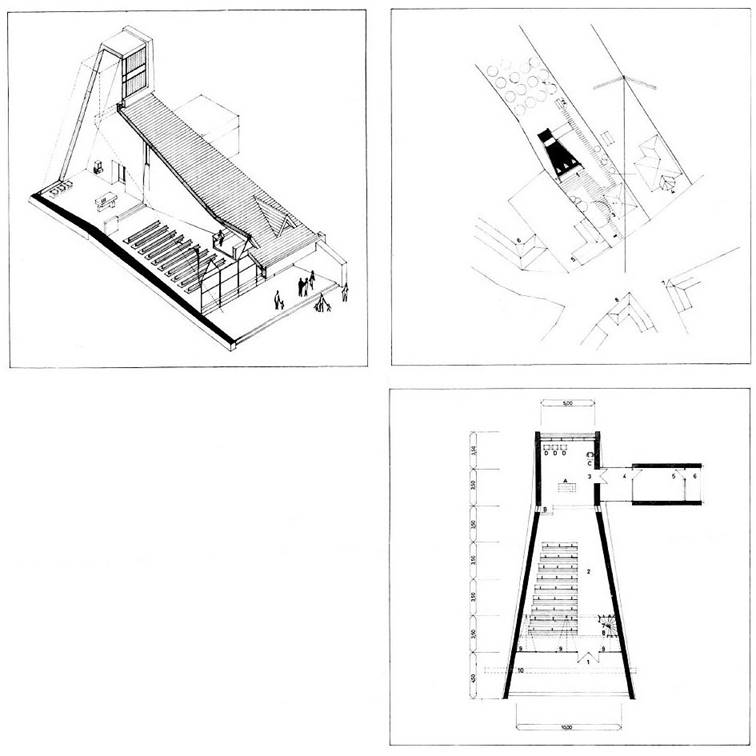
Fig. 20.
László Csaba, Hodász Catholic Church (Hungary), 1971-77; presentation
of the drawings in Magyar Építõmûvészet 27(3): 40.
Csaba’s
churches were held in high regard – they were mostly appreciated for his always
committed creative artistic stance, especially when dealing with the
difficulties of the era, at a time when the architect who took on the task of
building a church (due to political exposure) had to make many sacrifices. The
hierarchical spatial organization of the Hodász church, achieved with a late
modern toolkit, and the application of the direct axial spatial form, were
already resolved in his subsequent works; in the case of the Nyírderzs church
(1980-84), he formed an altar space with a similarly elevated space height and
rows of benches surrounding the presbytery on three sides; while his last major
churches (Kaposvár, 1983-88 and Békásmegyer, 1983-88) already demonstrated
efforts to centralize and unify the space. His early church architectural works
are decisive in assessing his oeuvre: the churches of Cserépváralja and
Hollóháza are listed on the Hungarian national Heritage Register, and have
recently been fully renovated, but its later churches are also well maintained,
and the living congregations take care not only of the buildings but also of
their works of religious art.
In addition
to modern architectural design, the struggles and ingenuity of a committed
architect are revealed in the desire of a small community to build despite the
atheistic political power. Through the history of the church in Hodász, created
between 1971 and 1977, we can see the clearer acceptance of modern architecture
at both the ecclesiastical and secular levels. The abstract modern space,
created with a symbolic composition of light, still carries the memory of a
unique era with its high-quality works of art.
BIBLIOGRAphy
Csaba, László. 1978. «Róm. kat. templom Hodász nagyközségben». Magyar Építõmûvészet 27(3): 40-43.
Delgado Orusco, Eduardo. 2007. «Las iglesias de Miguel Fisac». Actas de Arquitectura Religiosa Contemporánea 1: 130-161. https://doi.org/10.17979/aarc.2007.1.0.5021
Della Longa, Giorgio. 2007. «La arquitectura religiosa contemporánea en Italia y la experiencia de la Conferencia Episcopal Italiana en su promoción». Actas de Arquitectura Religiosa Contemporánea 1: 106-129. https://doi.org/10.17979/aarc.2007.1.0.5020
Fernández-Cobián, Esteban. 2005. El espacio sagrado en la arquitectura española contemporánea. Santiago de Compostela: Colexio Oficial de Arquitectos de Galicia.
Fernández-Cobián, Esteban. 2006. «Pianta longitudinale vs.pianta centrale: una lettura dalla Spagna». In Architectura e Liturgia nel Novecento 4. Esperienze europee a confronto, edited by Giorgio della Longa et al., 15-19. Venezia: Stella Edizioni.
Garai, Gréta and Zorán Vukoszávlyev. 2017. «Supreme Pastor of the Church Cares for
the Hungarian Church: Church Architecture of the Hungarian Church During the
First Decade of John Paul II’s Papacy». Periodica Polytechnica Architecture
48(1): 53–57. https://doi.org/10.3311/PPar.10882
Kovács,
Dániel and Zorán Vukoszávlyev. 2025. Csaba László, Munkás Szent
József-templom, Cserépváralja / László Csaba, Saint Joseph the Worker Church,
Cserépváralja. Budapest: MMA Kiadó.
Lantos,
Edit. 2009. «Római katolikus templomépítészet Magyarországon 1945 után. Az 1945
és 1957 közötti idõszak». Mûvészettörténeti Értesítõ 58(2): 223–244.
Lantos,
Edit. 2015. «Templom, idegenforgalmi érdekesség, bunker? Hollóháza templomának
építés- és fogadtatástörténete 1959–1967». Ars Hungarica 41(1): 64–73.
Lantos,
Edit. 2018. «Logikai készlet. Új építésû római katolikus templomok
(1960–1970)». Ars Hungarica 44(2): 163–191.
Lantos,
Edit. 2018. Római katolikus templomépítészet Magyarországon 1945–1970. PhD
thesis dissertation. ELTE Budapest.
Longhi, Andrea. 2012. «Chiese a pianta centrale e assemblee liturgiche: un concorso preconciliare». Architettura e Arte II s. 2012(2-4): 55-73.
Longhi, Andrea. 2018 «Architetture di chiese e vita ecclesiale: storie di progetti, cantieri e realizzazioni di centri parrocchiali italiani nel secondo Novecento». Arquitectura y Cultura 10: 4-96.
Rév, Ilona. 1984. «A templom korunk építészetében». Vigilia 49(2): 82-85.
Stock,
Wolfgang Jean (ed.). 2002. Europäischer Kirchenbau 1950–2000. European
Church Architecture. München: Prestel.
Stock,
Wolfgang Jean. 2004. Architectural Guide to Christian Sacred Buildings.
London: Prestel.
Urbán,
Erzsébet. 2019. «Templomépítészet a szocializmusban. Szerkezet, forma és
szakrális tartalom viszonya az 1970-1980-as évek magyarországi római katolikus
templomépítészetében». Építés–Építészettudomány 47(3–4): 323–359.
Urbán,
Erzsébet and Zorán Vukoszávlyev. 2016. «Resistance to oppression. Case study of
the Hungarian Catholic Church Architecture 1945-1989». Paper presented at the 14th International
DoCoMoMo Conference: Adaptive Reuse. Lisbon: DoCoMoMo International,
576-581.
Vukoszávlyev,
Zorán and Erzsébet Urbán. 2016. «Magyarország templomépítészete 1945–1964
között: Vázlat az alkotómûvészi értékeléssel megállapítható építészeti
folytonosságról». Építés-Építészettudomány 44(3-4): 247-315.
Vukoszávlyev, Zorán. 2017. «Materiality shaping immateriality: Immanence adn Transcendence in Contemporary Hungarian Church Architecture». In Architettura e liturgia. Autonomia e norma nel progetto, edited by Andrea Longhi, 105-115. Bologna: Bononia University Press.
Zahner, Walter. 2007. «La construcción de iglesias en Alemania durante los siglos XX y XXI. En busca de una casa para Dios y para el hombre». Actas de Arquitectura Religiosa Contemporánea 1: 38-71. https://doi.org/10.17979/aarc.2007.1.0.5017
SOURCE OF IMAGES
Fig. 01-19.
Archive of László Csaba.
Fig. 20. Magyar
Építõmûvészet 27(3): 40.
NOTES
[1] St. Ladislaus Roman Catholic Church in Hollóháza is an internationally renowned
work (Stock 2004: 312-313). The year 1997, which is listed as the date of
construction, is clearly a printing error; the correct year is 1967.
[2] The organization of the plans, photographs and manuscripts preserved in
the family archive was carried out by Dániel Kovács, an art historian and
research fellow at the MMA Hungarian Museum of Architecture and Monument
Protection Documentation Center. Cataloging has not yet been completed, so no
public collection identification numbers can be assigned to these documents
(state in October 2025). We would like to thank the heirs for their permission
and the researcher for his support in making the original documents available
for scholarly publication.
[3] In her assessment of the church architecture of the period, Erzsébet Urbán articulates her observations with precision, going beyond mere material, physical, and aesthetic characteristics: «The role of light, and its architectural representation, has taken on a more prominent role. During the liturgy performed in the built space, the mysticism of sacredness is conveyed most effectively by elements beyond our control, perceptible only through their presence. Perception arises from the contrast between temporal constancy and momentary changes: the value of the ideal lies in transience and change. The liturgy changes according to the preparatory periods and feasts of the Christian calendar: everything has its appointed time, and anticipation brings about the joyful moment of the event. The liturgy of the Word and music adapts to this. The church interior, however, due to its physical immobility, can only adapt to this cyclical nature to a limited extent. Light, the physical yet intangible element of the world around us, reveals the visual perception of earthly transience and renewal within the built space. In contrast to the light symbolism traditionally used for a long time, modern church architecture focuses on change...» (Urbán 2019: 333).