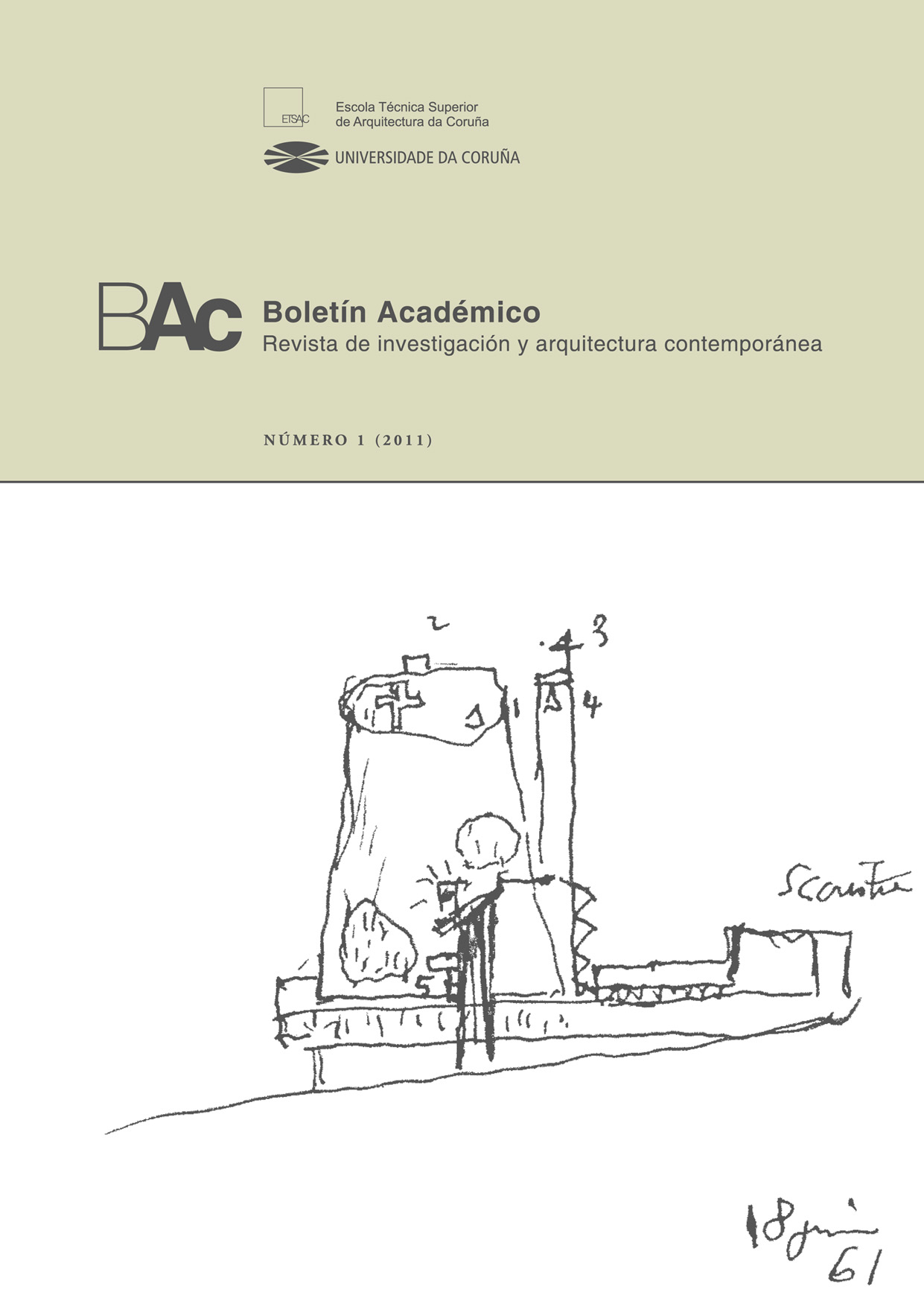
European religious architecture in the context of modernity
DOI:
https://doi.org/10.17979/bac.2011.1.0.959Abstract
It could be a paradox to talk about the introduction of modernity in the field of religious architecture due to the attitude of custody and continuation of a tradition that her promoters should maintain. However, we can see how modern churches emerged from the unity of a new theological and architectural vision, with the aim of building a new architecture with the features of the new world. The objective of this study is to show the basics that led to the radical change that have happened in the creation of sacred spaces in the whole of Europe from the beginning of the last century.Downloads
References
Borrás Feliú, Antoni. “Arquitectura religiosa contemporánea”, Arbor 204, 1962.
Compagnon, Antoine. Las cinco paradojas de la modernidad. Caracas: Monte Ávila, 1991.
Fernández Cobián, Esteban. El espacio sagrado en la arquitectura española contemporánea. Santiago de Compostela: COAG, 2005.
Jean Stock, Wolfgang. Europäischer Kirchenbau, 1950-2000/European Church Architecture. Munich: Prestel, 2002.
Klotz, Heinrich. “Visión de la Modernidad”. Summarios 107, 1986.
Le Corbusier. Hacia una arquitectura. Buenos Aires: Poseidón, 1964.
Mies van der Rohe, Ludwig. Escritos, diálogos y discursos. Murcia: COAAT, 1981.
Norberg-Schulz, Christian. Los principios de la arquitectura moderna. Barcelona: Reverté, 2005.
Schnell, Hugo. La arquitectura eclesial del siglo XX en Alemania. Munich/Zurich: Schnell & Steiner, 1976.
Stangos, Nikos. Conceptos de arte moderno. Madrid: Alianza, 1986.
Van Acken, Johannes. Christozentrische Kirchenkunst, ein Entwurf zum liturgischen Gesamtkunstwerk. Gladbeck: Theben, 1922.
VVAA. “Proyecto de catedral en Madrid. Sesión de Crítica de Arquitectura”. Revista Nacional de Arquitectura 123, 1952.