

Sobre la revista
IMPORTANT NOTICE
This journal has migrated to this new web address www.sportisjournal.com If you wish to register as a reader, author, or reviewer, you must do so through the new website.
Enfoque y alcance
La Revista Internacional Sportis tiene como objetivo la publicación y difusión de artículos de investigación relacionados con la Educación Física, el Deporte y la Psicomotricidad en niños, jóvenes y adultos. Los autores podrán presentar trabajos desarrollados en el ámbito de la investigación analítica (revisiones teóricas, de historia o síntesis), investigación cuantitativa, investigación experimental y/o investigación cualitativa.
Sportis es una publicación trimestral, publicando un total de 4 números al año. Las fechas de publicación de los números son las siguientes: 1 de enero, 1 de abril y 1 de julio y 1 de octubre de cada año.
La revista está editada por Campus Educa Sportis en colaboración con la Universidad de A Coruña.
Las 3 grandes áreas temáticas de la revista abarcan las siguientes subáreas:
SUBÁREAS TEMÁTICAS
SUBÁREAS TEMÁTICAS
|
ÁREA N.º 1. DEPORTE |
|
1.1. Pedagogía del deporte |
|
1.2. Gestión y Dirección Técnica de Escuelas Deportivas |
|
1.3. Organización de una escuela deportiva y de eventos deportivos |
|
1.4. Bases del entrenamiento de las capacidades físicas |
|
1.5. Ejercicio físico y salud |
|
1.6. Nuevas tendencias deportivas en el ámbito del deporte |
|
1.7. Inclusión e Integración a través del deporte |
|
1.8. Evaluación y calidad de los programas deportivos |
|
1.10. Los agentes implicados en el deporte |
|
1.11. Política deportiva. Programas socio-deportivos |
|
1.12. Prevención de lesiones en el deporte |
|
1.13. Primeros auxilios en el deporte |
|
1.14. La mujer en el deporte |
|
1.15. Ejercicio físico para la prevención y rehabilitación de patologías y enfermedades |
|
1.16. Recreación y ocio en el deporte |
|
1.17. Psicología, sociología y antropología del deporte |
|
1.18. Medicina deportiva, fisioterapia y nutrición en el deporte |
|
1.19. Competición deportiva |
|
1.20. Arbitraje y juicio en el deporte. Reglamentación Deportiva |
|
1.21.Proyectos de investigación en el deporte |
|
1.22. La sesión de entrenamiento en el deporte |
|
1.23. Anatomía, Fisiología y kinesiología en deportistas |
|
1.24. Deporte y actividades extraescolares. |
|
1.25. Técnica y táctica deportiva. |
|
1.26. Planificación y programación del entrenamiento deportivo. |
|
1.27. Preparación Física en los deportistas |
|
1.28. Responsabilidad civil en el deporte |
|
1.29.Movimiento olímpico en la población deportiva |
|
ÁREA N.º 2 EDUCACIÓN FÍSICA |
|
2.1. Competencias básicas a través de la Educación Física |
|
2.2. Adaptaciones Curriculares para alumnos con diversidad funcional |
|
2.3. Educación Física y Currículum Educativo |
|
2.4. Hábitos saludables y Educación Física |
|
2.5. La sesión de Educación Física y Unidades Didácticas |
|
2.6. Evaluación en Educación Física |
|
2.7. Nuevas tendencias en el ámbito de la Educación Física. Propuestas didácticas |
|
2.8. Juegos y actividades lúdico-deportivas |
|
2.9. Innovación e Investigación en Educación Física |
|
2.10. Juegos y deportes populares y tradicionales |
|
2.11. Animación Deportiva y socio-cultural |
|
2.12. Actividades en la Naturaleza |
|
2.13. Didáctica y Pedagogía de la Educación Física |
|
2.14. Expresión Corporal y técnicas artísticas en Educación Física |
|
2.15. Responsabilidad civil en el aula de Educación Física |
|
2.16. Prevención de la violencia a través de la Educación Física |
|
2.17. Educación Física y valores |
|
2.18. Prevención de accidentes en la escuela |
|
ÁREA N.º 3 PSICOMOTRICIDAD |
|
3.1. Motricidad infantil de 0 a 2 años |
|
3.2. Motricidad infantil de 3 a 6 años |
|
3.3. Aprendizaje, desarrollo y control motor a través de la actividad física |
|
3.4. Estimulación precoz en niños/as |
|
3.5. Bases del desarrollo de los factores de la psicomotricidad |
|
3.6. Habilidades motrices |
|
3.7. Estimulación sensorial en niños y niñas |
|
3.8. Juegos motores |
|
3.9. Canciones motrices y Cuentos motores |
|
3.10. Juegos de relajación y vuelta a la calma |
|
3.11. Programas de intervención motriz en educación infantil |
|
3.12. Investigación en prácticas psicomotrices |
|
3.13. Evaluación psicomotriz |
Proceso de evaluación por pares
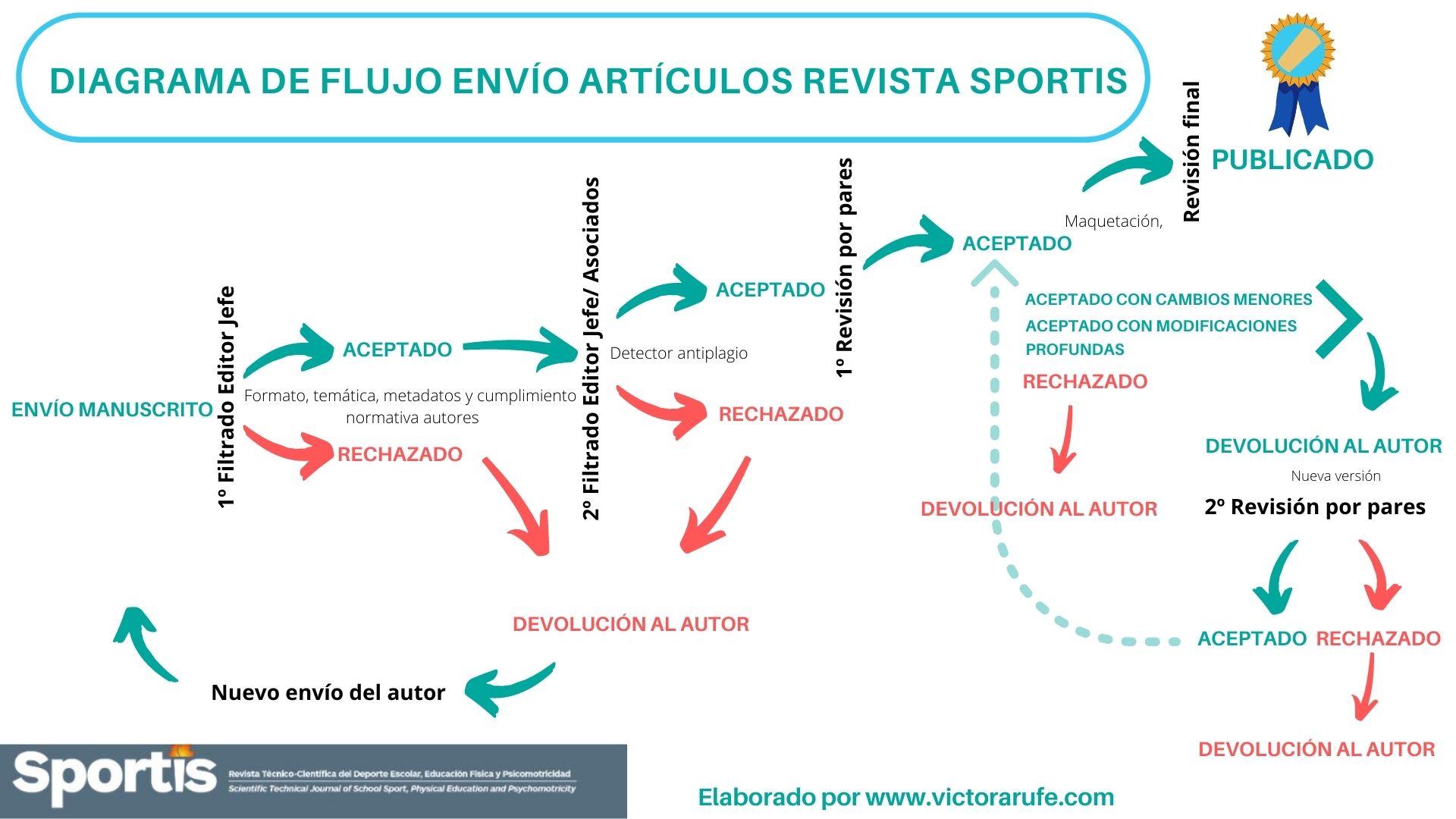
Todos los manuscritos recibidos serán revisados en primera instancia por el editor jefe o editores de sección, quienes decidirán si el artículo sigue la línea editorial de la revista y si cumple los requisitos formales establecidos en la normativa para autores.
Los manuscritos que no cumplan estas características formales serán devueltos a sus autores para que adapten el manuscrito a la normativa actual, y aquellos que no sigan la línea editorial serán rechazados para su publicación en la revista.
Los trabajos que presenten una correcta adecuación a la normativa vigente y que sigan la línea editorial de la revista serán remitidos de forma anónima a un mínimo de dos miembros del Comité Científico y/o revisores externos de la revista para su revisión. La revisión se realiza mediante un sistema doble ciego y revisión por pares. Los artículos podrán ser rechazados, aceptados con modificaciones o aceptados sin modificaciones.
El tiempo medio de revisión comprenderá entre 15 y 45 días. Comprometiéndose el editor, una vez finalizado este plazo, a enviar una resolución al autor del artículo.
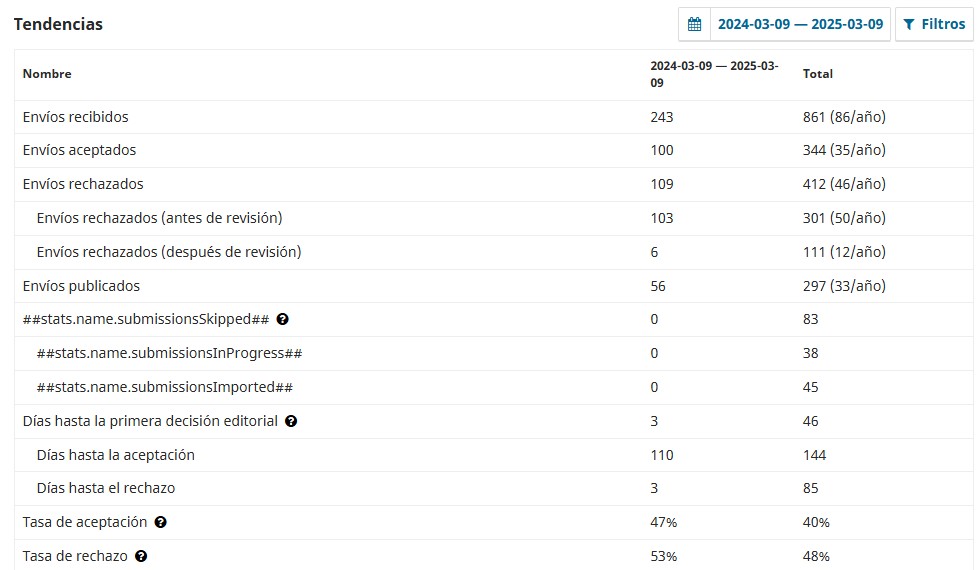
Estadísticas y ratio de aceptación (Informe año 09/03/2024 al 09/03/2025)
Frecuencia de publicación
Los artículos aceptados serán programados para su publicación en un número de la revista tan pronto como sea posible. La revista publica un total de 4 números al año. Las fechas de publicación son el 1 de enero, el 1 de abril, 1 de julio y el 1 de octubre.
Política de acceso abierto
Esta revista proporciona acceso abierto inmediato a su contenido, basado en el principio de que ofrecer al público un acceso libre a las investigaciones favorece un mayor intercambio global de conocimiento.
La revista no cobra ningún tipo de cuota a los lectores por acceder a los artículos científicos, ni exige tasas de suscripción.
No obstante, al no contar con financiación externa (ni pública ni privada), la dirección de la revista se ve obligada a cobrar una pequeña cuota a los autores para cubrir los gastos derivados del proceso editorial, entre ellos:
- Hosting y mantenimiento web
- Diseño, maquetación y producción
- Revisión ortotipográfica y científica
- Proceso de revisión por pares
- Expedición de certificados
- Secretaría y atención por correo electrónico
- Difusión en RRSS
- Corrección de metadatos
- Registros de DOI, indexación y otros costes asociados
La tasa editorial asciende a 200 euros y solo se abonará en caso de aceptación del artículo. El envío de trabajos y su revisión por pares son completamente gratuitos.
Buenas prácticas editoriales en igualdad de género.
Uso de Lenguaje Inclusivo y No Sexista
Sportis Sci J sigue una política editorial que incluye recomendaciones específicas a favor del uso de lenguaje inclusivo en los artículos científicos. Los autores deben utilizar términos que hagan alusión a ambos sexos, algunos ejemplos son: alumnado, docentes, infancia, niñez, personas, ser humano, profesorado, personal investigador, etc. Los autores deben incorporar siempre los dos apellidos de todo el personal que participó en la investigación.
En consonancia con nuestra política editorial, recomendamos encarecidamente a los autores el uso de un lenguaje inclusivo y no sexista en sus artículos científicos. Estas recomendaciones están diseñadas para asegurar que todos los trabajos publicados en nuestra revista respeten y reflejen la diversidad de nuestra comunidad científica, promoviendo la igualdad y evitando cualquier forma de discriminación.
Algunas pautas a seguir incluyen:
- Uso de Pronombres Neutros: Utilizar pronombres inclusivos o formas que engloben todos los géneros cuando se refiera a individuos de manera general.
- Evitar Estereotipos de Género: Redactar de manera que se eviten los estereotipos y roles de género tradicionales.
- Lenguaje Neutral: Preferir términos neutros de género como "personas" en lugar de "hombres" o "mujeres", a menos que sea necesario especificar.
- Reconocimiento Equitativo: Asegurarse de reconocer las contribuciones de todas las personas involucradas en la investigación, sin importar su género.
- Formas de Referencia: Cuando se refieran a profesionales, usar el título y el nombre completo, y no solo el apellido, para evitar sesgos de género.
Estas recomendaciones están en línea con nuestro compromiso con la equidad y la diversidad en la ciencia. Agradecemos la cooperación de todos los autores en la implementación de estas prácticas en sus manuscritos.
Recomendamos a los/as autores/as de trabajos publicados que hayan sido realizados con datos de
investigación entre los que se encuentre la variable sexo, que informen sobre si las conclusiones han tenido en cuenta posibles diferencias entre sexos
Detección de plagio
La revista SPORTIS utiliza el programa de detección de plagio Similarity Check de Crossref. Todos los artículos antes de pasar a revisión por pares son chequeados por el programa antiplagio. Si el editor observa un porcentaje de plagio superior al 20% o un porcentaje excesivo de autocitas sin estar justificado automáticamente el artículo será devuelto al autor sin tramitar su revisión por pares. El detector antiplagio se pasa en dos ocasiones durante el proceso editorial, al recibirse el artículo por primera vez y la última versión del artículo antes de ser publicado.
Normativa para autores
NORMAS PARA AUTORES/AS
Sportis Revista Técnico-Científica es una publicación trimestral y considera para su publicación manuscritos originales relacionados con las áreas del deporte, educación física y psicomotricidad en la infancia, niñez, adolescencia y adultez. Una vez que el autor envíe el artículo para su revisión y publicación, si procede, Sportis adquiere todos los derechos exclusivos sobre la publicación de los trabajos seleccionados. Los conceptos, juicios y opiniones expresados en los artículos serán responsabilidad de los autores.
Se recomienda a los autores antes de enviar un artículo que visualicen el siguiente vídeo explicativo sobre cómo enviar un artículo y cubrir los metadatos en la web de la revista (CLICK AQUÍ)
Los interesados en publicar en Sportis deben leer detenidamente y ajustarse a las siguientes instrucciones contempladas aquí:
1.- Normas Generales
1.1 Los trabajos enviados para su publicación deben ser inéditos y no se permite su presentación simultánea en otra revista. Sportis tiene todos los derechos autorales de los trabajos publicados, sin embargo, permite su posterior transcripción citando la fuente adecuadamente. La revista no contempla ningún tipo de remuneración para los autores.
1.2 Sportis podrá recibir para su publicación trabajos únicamente presentados los siguientes idiomas: español e inglés, siendo responsabilidad de los autores los textos y sus respectivas traducciones cuando ello fuese necesario. Los trabajos deben ser de una redacción precisa y clara, evitando las ambigüedades. Los autores deben enviar obligatoriamente el título, resumen y palabras claves del artículo en inglés y en español, pudiendo enviar el texto completo en cualquiera de estos idiomas.
1.3 Sportis se reserva el derecho de someter todos los trabajos originales a la apreciación del Comité Editorial, Científico y los revisores externos que ellos designasen. Todas las revisiones de los artículos serán por pares y sistema doble ciego. Cuando fuese necesario, la dirección de la revista podrá solicitar la revisión del artículo a un tercer, cuarto o quinto revisor.
1.4 Los trabajos aceptados serán publicados en la web de la revista e incorporados al número y volumen correspondiente.
1.5 Las fechas de recepción, aceptación y publicación online del trabajo estarán, en forma obligatoria, al final de los datos del autor y antes del resumen, en la primera página de cada artículo cuando sea publicado.
2.- Formatos
Los autores podrán presentar trabajos desarrollados en el ámbito de la investigación analítica (revisiones teóricas, de historia o síntesis), investigación cuantitativa, investigación experimental y/o investigación cualitativa. Todos los artículos deben venir en esta plantilla, disponible en dos idiomas (español e inglés) (CLICK AQUÍ)
La dirección de la revista establece los siguientes formatos de artículos:
2.1. Artículos originales: Incluye investigaciones cuantitativas, experimentales, cualitativas o estudios de caso, en el ámbito del deporte, educación física o psicomotricidad en la infancia, niñez, adolescencia o adultez. La extensión máxima del cuerpo del manuscrito será de 6000 palabras, incluyendo un mínimo de 30 referencias bibliográficas actualizadas (50% de los últimos cinco años) y resúmenes en español e inglés.
2.2. Revisiones de la literatura: Incluyendo aquellas de carácter sistemático y narrativo, correspondientes a temáticas vinculadas al foco de la revista, educación física, deporte o psicomotricidad en la infancia, niñez, adolescencia o adultez. Los autores pueden contemplar las subáreas en la normativa de la revista. La extensión máxima del cuerpo del manuscrito es de 8000 palabras, incluyendo hasta 100 referencias bibliográficas actualizadas (50% de los últimos cinco años) y resúmenes en español e inglés. Para aquellas de carácter sistemático se exige el uso de la Declaración PRISMA (Preferred Reporting Items for Systematic reviews and Meta-Analyses, Ítems de Reporte Preferidos para Revisiones Sistemáticas y Meta-Análisis) http://www.prisma-statement.org/PRISMA%20Spanish%20Sept%202010.pdf.
2.3. Por necesidades editoriales y/o acuerdos con el autor, estos formatos pueden variar en beneficio de la misión de Sportis.
3.- Plan de Evaluación continua de mejora de la calidad editorial
La revista tiene establecido un plan de evaluación continua de mejora de la calidad. Dentro de este plan se solicita a los autores la inclusión obligatoria de los DOI de todas las referencias que tengan dicha identificación, así como una búsqueda de los ar´ticulos publicados en los últimos 5 años realizada en las bases de datos Web of Science y Scopus.
- Realizar una búsqueda en Web of Science y Scopus de artículos publicados en los últimos 5 años que puedan ser citados en su trabajo.
- Acceda a este link https://apps.crossref.org/simpleTextQuery Copie y pegue las referencias bibliográficas de su artículo en el espacio indicado dentro del link anterior. La plataforma le indicará qué referencias tienen DOI. Posteriormente copie y pegue cada DOI completo y añádalo al final de cada una de sus referencias del artículo. Es muy importante que cada referencia bibliográfica de su trabajo lleve su DOI correspondiente al final de la misma, en caso de tenerlo. Esto permite a los motores de búsqueda la localización más rápida y fácil de encontrar los trabajos citados por otros autores y es un requisito de calidad de nuestra revista.
Ejemplo de cómo debe ir el DOI al final de cada referencia bibliográfica
Yanci, J., Arcos, A. L., Castillo, D. y Cámara, J. (2017). Sprinting, Change of Direction Ability and Horizontal Jump Performance in Youth Runners According to Gender. Journal of Human Kinetics, 60(1), 199–207. https://doi.org/10.1515/hukin-2017-0103
4.- Presentación del manuscrito
4.1. Formato general del manuscrito
Los manuscritos presentados a Sportis deben ser escritos a espacio interlineado de 1,5 líneas (excepto el resumen y palabras clave que estarán con interlineado sencillo) y sin espaciado de párrafo anterior y/o posterior, en hoja tamaño dinA4 (21 x 29,7 centímetros), con márgenes de 3 centímetros en su borde superior e inferior y de 2,5 centímetros en su borde derecho e izquierdo, en fuente Time New Roman con caracteres de tamaño 12pt, tinta negra y páginas numeradas en el centro del pie de página y desde la primera página. El inicio de cada párrafo durante el texto irá marcado con una tabulación de 1.25 puntos, excepto en el resumen. Los títulos de los apartados del artículo irán en negrita y minúscula (sólo la primera letra en mayúscula).
Los autores enviarán dos únicos archivos de word. El primero de ellos contendrá el título del artículo en español e inglés, los datos de los autores y sus afiliaciones y los datos del autor de correspondencia en español e inglés. Además de los datos relativos a la financiación, consentimiento informado, conflicto de interés y participación de los autores en el texto. Estos últimos datos se cubrirán de la siguiente forma
Contribución específica de los autores: Señalar cada uno de los apartados del artículo y entre paréntesis indicar las iniciales de los autores que han participado en ellos.
Financiación: Señalar si el artículo es fruto de una investigación financiada, en caso de no tener financiación indicar No existió financiación para este proyecto.
Consentimiento informado participantes del estudio: Señalar si fue obtenido y en caso de no proceder, indicar No procede.
Conflicto de interés Señalar si existe algún conflicto interés, en caso de no existir indicar Los autores no señalan ningún conflicto de interés.
A este archivo se le denominará DATOS AUTORES.
Y en otro archivo de word se incorporará el texto completo del artículo con el título, resumen y palabras clave en español e inglés. Este archivo no llevará los datos de los autores, será anónimo y será el que se pase a la revisión por pares. A este archivo se le denominará TEXTO COMPLETO.
4.2. Archivo DATOS DE AUTORES (Inlcuye datos de los autores, título, resumen y palabras clave).
- El título del artículo debe ser informativo y conciso del trabajo que se presenta, con un máximo de 15 palabras, en español e inglés. Irá en negrita, minúscula y centrado. Interlineado de 1.5 puntos.
- Debe identificarse claramente a los autores con su nombre de pila y dos apellidos. Estos irán situados debajo del título, en minúscula, sin negrita y centrado. Se colocará el nombre y apellidos de cada uno con separación con punto y coma. El nombre de cada autor debe coincidir exactamente con el que se incorpore en los metadatos de la plataforma. La revista no admitirá cambios de autores una vez enviado el trabajo.
- La(s) afiliación(es) de cada autor al momento de la realización del trabajo deberá ir situada debajo de los autores, si todos fuesen de la misma institución, se pondrá el nombre de la institución debajo de los autores, si fuesen de diferentes instituciones, se indicará mediante números la afiliación de cada uno y siempre colocadas debajo de los autores (ver modelo en artículos ya publicados).
- Email de contacto del responsable de la publicación. Se colocará debajo de la afiliación, sin negrita y centrado.
- Fuente de apoyo financiero cuando ello correspondiera, con la identificación del proyecto y la institución patrocinadora.
- En otra página diferente se colocará el resumen, en español seguido de las palabras clave separadas por punto y coma y en minúscula (máximo 5 palabras utilizando preferentemente el Tesaurus Sportdiscus/UNESCO y asegurándose que las que figuran en el manuscrito estén incorporadas también correctamente, en cantidad y orden, en los metadatos en la web), y a continuación el resumen en inglés con sus respectivas palabras clave nuevamente separadas por punto y coma. La extensión total del resumen debe ajustarse a no más de 250 palabras. El resumen debe contener una o dos líneas sobre la fundamentación del trabajo, una o dos líneas con el objetivo, una o dos líneas con la metodología, una o dos líneas con los resultados y una o dos líneas con las conclusiones. Los trabajos que no contemplen esto serán rechazados. El resumen y las palabras claves contarán con interlineado sencillo.
- El resumen no debe contener los títulos de los apartados.
4.3. Archivo de TEXTO COMPLETO
- En otro archivo diferente se incoprorará de nuevo el título en español e inglés, el resumen y las palabras clave separadas por punto y coma (máximo 5 palabras utilizando preferentemente el Tesaurus Sportdiscus y asegurándose que las que figuran en el manuscrito estén incorporadas también correctamente, en cantidad y orden, en los metadatos en la web) ambos también en español e inglés. La extensión total del resumen debe ajustarse a 250 palabras. Para las comunicaciones bajo el formato de artículos originales y protocolos/avances de investigación este debe estar estructurado bajo el formato IMRD, incluyendo una breve introducción, el objetivo del trabajo, la metodología, los resultados y la discusión/conclusión principal. El resumen y las palabras claves contarán con interlineado sencillo.
- Se deben incluir 3 a 5 palabras claves en español e inglés, privilegiando términos incluidos en el Tesauro de Sport Discus . Los títulos de los apartados irán siempre en negrita y en minúscula.
Posteriormente se incorporará el texto completo y todo el archivo estará anonimizado.
4.3.1 Para artículos originales debe seguir la estructura IMRD de acuerdo a las Guías de Reporte Equator Network propias del diseño del estudio presentado, conteniendo en cada sección:
- Introducción/Fundamentación: Debe presentar una contextualización del tema, referenciando investigaciones recientes y estableciendo claramente la importancia o interés de haber desarrollado el estudio. Terminar con la exposición del objetivo de la investigación en forma concreta. Redactado en tiempo presente y tercera persona.
- Material y método: Se debe identificar los métodos, equipos y procedimientos con los suficientes detalles que permitan su reproducción por otros investigadores. Métodos ya publicados deben ser citados y los que sean poco conocidos, modificados o nuevos deber ser descritos en forma breve. Debe incluir una adecuada descripción de: a) Diseño del estudio; b) Población de interés; c) Criterios de selección; d) Variables; e) Medición y/o seguimiento; f) Análisis estadístico; y g) Consideraciones bioéticas. Redactado en tercera persona tiempo pasado.
- Resultados: Deben presentarse en forma ordenada y coherente, sin comentarios ni explicaciones personales, resaltando los más relevantes al objetivo del estudio. Pueden ser acompañados por un máximo de 6 tablas y/o gráficos y/o figuras cuando sea necesario para una mejor comprensión. Estas se insertarán en su lugar correspondiente en el texto. Las tablas, figuras e imágenes cumplirán con la normativa APA 6º o 7º edición (elegir solo un estilo) e irán con una leyenda a pie de la misma en el caso de imágenes, gráficos y figuras, y una leyenda en la parte superior en el caso de tablas. Todas ellas irán numeradas con números arábigos correlativos. Ej. Tabla nº 1. Niveles de fuerza de niños de 12-13 años.
- Discusión: Enfatizar los aspectos nuevos e importantes del estudio, interpretando los resultados obtenidos sin volver a repetirlos. Relacionar al conocimiento ya existente, señalando las coincidencias y discrepancias con otros estudios relevantes sobre el tema.
- Conclusiones: Cuando la naturaleza del estudio y sus resultados lo permitan. Deben concordar con los objetivos propuestos y ser sustentados por los resultados obtenidos, dando así una respuesta a la hipótesis de trabajo planteada. El autor deberá concretar en unas líneas la aportación a la comunidad científica, más destacada, de su trabajo. Recomendable incorporar limitaciones del trabajo y propuestas de mejora o líneas de investigación futuras.
4.3.2 Para artículos de revisión de literatura, sistemática o metaanálisis debe seguir la estructura IMRD de acuerdo a las Guías de Reporte Equator Network propias del diseño del estudio presentado y contemplando las recomendaciones del protocolo PRISMA (Click aquí).
- Introducción/Fundamentación: Debe presentar una contextualización del tema, referenciando investigaciones recientes y estableciendo claramente la importancia o interés de haber desarrollado el estudio. Terminar con la exposición del objetivo de la investigación en forma concreta. Redactado en tiempo presente y tercera persona.
- Material y método: Se debe identificar los métodos, equipos y procedimientos con los suficientes detalles que permitan su reproducción por otros investigadores. Métodos ya publicados deben ser citados y los que sean poco conocidos, modificados o nuevos deber ser descritos en forma breve. La revisión debe incluir una adecuada descripción de: a) Diseño del estudio; b) Población de interés; c) Criterios de selección; d) Variables; e) Medición y/o seguimiento; f) Análisis de los datos; y g) Consideraciones bioéticas. Redactado en tercera persona tiempo pasado.
- Resultados: Deben presentarse en forma ordenada y coherente, sin comentarios ni explicaciones personales, resaltando los más relevantes al objetivo del estudio. Pueden ser acompañados por un máximo de 6 tablas y/o gráficos y/o figuras cuando sea necesario para una mejor comprensión. Estas se insertarán en su lugar correspondiente en el texto. Las tablas, figuras e imágenes cumplirán con la normativa APA 6º o 7º edición (elegir solo un estilo) e irán con una leyenda a pie de la misma en el caso de imágenes, gráficos y figuras, y una leyenda en la parte superior en el caso de tablas. Todas ellas irán numeradas con números arábigos correlativos. Ej. Tabla nº 1. Niveles de fuerza de niños de 12-13 años.
- Discusión: Enfatizar los aspectos nuevos e importantes del estudio, interpretando los resultados obtenidos sin volver a repetirlos. Relacionar al conocimiento ya existente, señalando las coincidencias y discrepancias con otros estudios relevantes sobre el tema.
- Conclusiones: Cuando la naturaleza del estudio y sus resultados lo permitan. Deben concordar con los objetivos propuestos y ser sustentados por los resultados obtenidos, dando así una respuesta a la hipótesis de trabajo planteada. El autor deberá concretar en unas líneas la aportación a la comunidad científica, más destacada, de su trabajo. Recomendable incorporar limitaciones del trabajo y propuestas de mejora o líneas de investigación futuras.
4.4. Referencias bibliográficas
Deben citarse a medida que aparecen en el texto utilizando la normativa APA 6ª o 7ª edición, los autores deben elegir una de ellas y cumplir un único formato/estilo en todo el manuscrito. Dicha normativa también será utilizada para la citación de autores, colocación de tablas, figuras, imágenes y gráficos. Muy importante, los autores deben comprobar en esta aplicación https://search.crossref.org/references los DOI de los artículos que tengan referenciados. Una vez localizados los incorporarán a las referencias bibliográficas. Es obligatorio que todas las referencias incorporen su DOI, salvo que no lo tengan. Las referencias se colocarán sin numeración. En los metadatos se deberá dejar una línea en blanco de separación entre referencia y referencia. El no cumplimiento de esto puede ser motivo de rechazo del artículo.
4.5. Ilustraciones, tablas y gráficos
Deben ser construidos en programas apropiados para Word. Las tablas, cuadros, gráficos, figuras y fotografías deben ser numeradas en forma secuencial con numeración arábiga y estar citados sin excepción en el texto entre paréntesis. Las tablas se numerarán de esta forma (Tabla n.º 1, Tabla n.º 2, etc.) al igual que las ilustraciones, gráficos, etc. (Figura n.º 1, Figura n.º 2, etc.). La leyenda para las tablas irá en la parte superior de la misma centrada, para el resto de casos irá en la parte baja centrada de la figura/imagen/gráfico sin negrita y en letra de 10 puntos e interlineado sencillo. Todas ellas se insertarán en su lugar del texto.
- Las tablas y los gráficos deben llevar título y las abreviaciones poco comunes deben ser explicadas en la parte inferior de la misma. Las tablas llevarán interlineado sencillo, es responsabilidad del autor colocar las tablas correctamente en el lugar del texto donde deben ir.
- Las fotografías e ilustraciones deben tener un tamaño adecuado para su correcta visualización y una resolución de 300ppp o dpi (puntos o pixeles por pulgada), una imagen de 10x7,5 centímetros debería tener una resolución aproximada de 1200x900 pixeles. Toda leyenda en las ilustraciones debe ir en la parte inferior de las mismas.
4.6. Términos Científicos
Los términos científicos no deben ser escritos en forma abreviada. Las unidades de medida deber ser presentadas de acuerdo al Sistema Internacional de Medidas de manera rigurosa.
5.- Evaluación
El tiempo de revisión máximo, desde la confirmación de la recepción hasta la primera respuesta, será máximo de 45 días. El tiempo promedio de revisión en el Sportis se puede consultar en la web de la revista, en el apartado de estadística, así como el porcentaje de artículos aceptados y rechazados. En ocasiones, debido a circunstancias especiales el tiempo de revisión puede dilatarse en 30 días más.
5.1 Todos los manuscritos serán sometidas a la evaluación por pares con sistema doble ciego.
5.2 Los originales que no cumplan cualquiera de las normas aquí publicadas, en relación a su presentación, serán devueltos para su corrección antes de ser evaluados.
5.3 Cada trabajo será revisado al menos por 2 expertos del área abordada en el trabajo y siempre de forma anónima.
5.4 Los pares revisores podrán sugerir el rechazo, la necesidad de cambios menores, cambios mayores o la aceptación del manuscrito. En todas las instancias se comunicará a los autores las apreciaciones de los revisores, en conjunto con la decisión editorial.
- En caso de que se soliciten cambios menores, el manuscrito será aceptado una vez que este incluya las modificaciones solicitadas, sin necesidad de nuevos revisores.
- En el caso de cambios mayores, el manuscrito con las modificaciones será evaluado por uno solo de los revisores iniciales, esto con el objetivo de dar la mayor coherencia y fluidez al proceso. Esta nueva revisión tomará un máximo de 30 días.
- En caso de rechazo quedará a discreción editorial la posibilidad de realizar un nuevo envío del manuscrito modificado o su rechazo definitivo.
5.5 Los trabajos aceptados serán asignados y publicados al primer número de la revista que tuviese disponibilidad y de acuerdo a las necesidades de la Revista. Los autores conocerán en el momento de aceptación dichos datos y la fecha de publicación
5.6 Sportis cumple estrictamente las fechas de publicación de los números de la revista, siendo estas las siguientes de cada año: 1 de enero, 1 de abril, 1 de julio y 1 de octubre. Se editan 4 números al año con periodicidad trimestral. Todos los usuarios inscritos en la revista recibirán en su email cada número nuevo que se publique.
6.- Envío de los manuscritos: Los manuscritos deben enviarse única y directamente al editor de la revista, Dr. Víctor Arufe Giráldez, Editor Jefe Revista Técnico-Científica Sportis, para ello el autor deberá registrarse como autor y lector en la web de la revista para posteriormente subir el artículo y consultar el proceso del mismo accediendo con sus claves. En el proceso de envío se recomienda a los autores marcar la opción de revisor, para colaborar así con la revista en la revisión de otros manuscritos.
LISTA DE COMPROBACIÓN DE PREPARACIÓN DE ENVÍOS. CHECK LIST
Se facilita a los autores un listado de aspectos que deben comprobar antes de enviar su artículo. Este checklist contiene los aspectos más importantes de la normativa y el mismo pretende evitar el rechazo de artículos por errores de formato.
- El artículo no ha sido publicado previamente, ni se ha presentado a otra revista (o se ha proporcionado una explicación en Comentarios al editor).
- El manuscrito ha sido preparado siguiendo estrictamente lo indicado en las instrucciones a los autores.
- Al menos el 50% de las referencias bibliográficas son del último quinquenio. Se utiliza el formato APA 6ª o 7ª edición.
- El texto tiene interlineado 1,5; el tamaño de fuente Time New Roman es 12 puntos; y todas las ilustraciones, figuras y tablas están correctamente identificadas en el texto (las tablas con la leyenda en la parte superior centrada y sin negrita, y las imágenes y figuras con la leyenda en la parte inferior, centrada y sin negrita.
- Los márgenes de la página son los siguientes 3 centímetros en su borde superior e inferior y de 2,5 centímetros en su borde derecho e izquierdo.
- El resumen y las palabras clave están maquetados con interlineado sencillo y sin tabulación. La separación entre el título y el texto será de 1,5 puntos.
- El título del artículo tanto en inglés como en español está en negrita, Time New Roman 12 puntos, interlineado de 1.5 puntos y centrado. Debajo del título se incorpora el nombre y apellidos de los autores, los autores estarán separados por punto y coma. Debajo de los autores figurará el centro de trabajo y debajo de este el email de contacto. Todo esto último se redactará sin negrita.
- Cada párrafo del texto se inicia con tabulación de 1,25 puntos en la primera línea del párrafo.
- Las tablas y las leyendas de tablas cuentan con tamaño de letra Time New Roman 10 puntos, interlineado sencillo y la leyenda está situada en la parte superior y centrada, sin tener letra en negrita y con numeración.
- Las fotografías, imágenes, gráficos y figuras están con tamaño de letra Time New Roman 10 puntos, leyenda en la parte inferior, sin negrita, centrada y con numeración.
- Las referencias tienen su DOI incorporado tras pasarlas por el buscador de DOI https://search.crossref.org/references
- Confirmo que los metadatos correspondientes al título, resumen y palabras claves del artículo están en ambos idiomas (español e inglés). Los artículos que no cumplan esta premisa serán rechazados.
- Confirmo que envío dos archivos de Word separados: DATOS AUTORES y TEXTO COMPLETO. El primer archivo incorpora todos los datos de los autores indicados en la normativa de envíos; nombre y apellidos completos de todos los autores y su orden de aparición, afiliaciones, ORCID e email de contacto del autor principal. El segundo archivo incorpora el título del del trabajo, resumen y palabras claves en ambos idiomas; español e inglés, seguido del texto completo del trabajo con las diferentes secciones o apartados y finalmente las referencias bibliográficas según normas APA sexta edición y con inclusión de los DOI de todos los artículos que lo tengan.
- Soy conocedor que esta revista al no disponer de financiación pública o privada se ve obligada al cobro de una pequeña tasa a los autores para mantener los estándares mínimos de calidad y toda la estructura profesional de la misma y abonar los honorarios de los trabajadores que participan en ella: informáticos, secretaría, maquetadores, etc. Esta tasa situada en 200 euros (impuestos incluidos) solo se cobrará en caso de que el artículo sea aceptado. El envío del artículo y su revisión no implica ningún coste. Esta tasa se abonará una vez que es aceptado y es necesaria para mantener los estándares de calidad de la revista.
NOTA DE COPYRIGHT
Los derechos autorales de todos los artículos publicados en Sportis pertenecen a Sportis. Se autoriza la publicación de la información presente en la revista siempre cuando esta sea correctamente citada (Sportis).
DECLARACIÓN DE PRIVACIDAD
Los nombres y direcciones de correo-e introducidos en esta revista se usarán exclusivamente para los fines declarados por esta revista y no estarán disponibles para ningún otro propósito u otra persona.
Ejemplo de presentación de artículo para su evaluación según normas de la Revista
Conocimientos previos y adquiridos tras una jornada de formación sobre primeros auxilios en futuros docentes de Educación Física
Prior and acquired knowledge after a day of training on first aids in future teachers of Physical Education
Rubén Navarro Patón; Pablo García Marín; José Eugenio Rodríguez Fernández
Facultad Formación de Profesorado. Campus de Lugo. Universidad de Santiago de Compostela.
Contacto: ruben.navarro.paton@usc.es
Contribución específica de los autores: Introducción (RNP), Metodología (PGM, RNP), Resultados (JERF, RNP), Discusión y Conclusiones (PGM)
Financiación: No existió financiación para este proyecto.
Consentimiento informado participantes del estudio: Se obtuvo consentimiento informado.
Conflicto de interés: Los autores no señalan ningún conflicto de interés.
Resumen
Con esta investigación se pretendió indagar acerca de los conocimientos sobre primeros auxilios, y en especial de RCP, que poseía el alumnado del grado de maestro en Educación Primaria de la Facultad de Formación de Profesorado de Lugo, antes y después de recibir una jornada de formación teórico-práctica de 3 horas en tres fases (1- expositiva-demostrativa, 2- interactiva con resolución de problemas en pequeños grupos y 3- interactiva con resolución de problemas en gran grupo). La muestra (N=23) estuvo compuesta por 9 hombres (39,1%) y 14 mujeres (60,9%) matriculados en la mención de Educación Física. Para saber los conocimientos previos (CI) y adquiridos (CF) tras la jornada de formación, se administró un cuestionario Ad Hoc con 25 ítems. Los resultados descriptivos del CI revelaron una falta de conocimiento de los futuros docentes de Educación Física en relación a los primeros auxilios. Los datos arrojados por el CF, alcanzando una media del 90 % de preguntas correctamente contestadas, avalan la eficacia de la metodología y duración de la formación propuesta a corto plazo. La retención de los conocimientos se presenta como limitación del estudio y será evaluada más adelante. En conclusión, se destaca la importancia de que los futuros docentes de Educación Física se formen adecuadamente en la materia de primeros auxilios y se propone que forme parte de los contenidos del grado en Educación Primaria.
Palabras clave
Accidentes; emergencias; protocolos; evaluación inicial; formación; evaluación final; profesorado..
Abstract
This research was intended to investigate (test) the knowledge of the students of master degree in Elementary Education from the Faculty of Teacher Training Lugo about their knowledge on first aid and C.P.R, before and after receiving a theoretical day training practice of three hours in three different ways (First(1)-exhibition-demonstration, Second(2)- solving a practical situation of the problem in small groups and third(3)- solving a practical situation of the problem with a large group). The sample (N = 23) consisted of 9 men (39.1%) and 14 women (60.9%) studying the degree of P.E. To find out the previous knowledge about the topic and at the end of the training session we created a test that was giving to them previous the training First test(FT) and after training day Second test(ST) to see the progress of the students after the training , a questionnaire with 25 items Ad Hoc was given. The descriptive results of the FC revealed a lack of knowledge of future teachers in the P.E topic of first aid. These procedures have been identified to make an improvement of the new teachers with appropriated training sessions. In data obtained from the ST, we reach on average more than a 90% of correct answers proving the efficacy of the methodology and duration of training given in short period of time. The retention of knowledge about this topic was shown as a limitation of the study and will be evaluated later on. In conclusion, the importance of the knowledge on the topic first aid and C.P.R in future teachers of P.E is proved after doing the test and is proposed as part of the topics to be teach on the degree.
Key Words
Accidents; emergencies; protocols; initial assessment; training; final assesment.
Indexación en Bases de datos y Directorios
Sportis Scientific Technical Journal cuenta con los siguientes índices de calidad:
Sello de Calidad FECYT Revistas Científicas Españolas 2023 y 2024
Impacto JIF (JCR 2022): 0.7 Q3 2023
3º Cuartil JCI del índice JCR2022 de Web of Science. Factor de impacto 0.49
1º Cuartil Dialnet Métricas 2020. Factor de impacto 0.90 (Posición 42/228 en EDUCACIÓN y Posición 11/43 en DEPORTE).
1º Cuartil Métrica REDIB 2019. Calificador Global 23,01 (Posición 155/1160) EDUCACIÓN.
ICDS de MIAR 7.3 en el año 2020
Y está indexada en:
SCOPUS, WEB OF SCIENCE, EBSCO, SPORTDISCUS, QUALIS CAPE DOAJ,REDIB, ERIHPLUS, CARHUS PLUS+, LATINDEX, CSIC-ISOC, DIALNET, SCIENCE OPEN, QUALITY OPEN ACCESS MARKET, CROSS REF, ALTMETRIC, GOOGLE SCHOLAR, BIBLIOTECA NACIONAL DE ESPAÑA, MIAR, DULCINEA, SHERPA/ROMEO, RESEARCHGATE, CNEN-Livre, BOISE STATE UNIVERSITY USA, WORLD WIDE SCIENCE, IBECS BIBLIOTECA VIRTUAL DE SALUD REGIONAL OPENALEX.ORG

Servicio de traducción al inglés para autores
La revista presenta un servicio de traducción al inglés para aquellos autores que lo deseen utilizar. Los interesados deberán enviar un email a sportis@sportis.es solicitando un presupuesto del texto que deseen traducir. El coste por palabra traducida es de 0.10 céntimos.
Periodicidad de publicación
Sportis. Revista Técnico Científica del Deporte Escolar, Educación Física y Psicomotricidad tiene una periodicidad trimestral, publicando un total de 4 números al año. Las fechas de publicación de cada número son las siguientes: 1 de enero, 1 de abril, 1 de julio y 1 de octubre. Sportis garantiza el cumplimiento estricto de estas fechas cumpliendo así con los criterios de calidad establecidos por numerosas plataformas de evaluación de revistas científicas.
Uso de Inteligencia artificial (IA)
La revista SPORTIS. Scientific Technical Journal of School Sport, Physical Education and Psychomotricity manifiesta su plena adhesión a los principios establecidos en la Declaración de Heredia: Principios sobre el Uso de la Inteligencia Artificial en la Edición Científica. (Click aquí)
Como publicación comprometida con la calidad, la ética y la integridad académica, asumimos los lineamientos de esta Declaración para garantizar un uso responsable, transparente y seguro de herramientas de inteligencia artificial en todos los procesos editoriales. Esto implica que:
-
La responsabilidad sobre los contenidos recae exclusivamente en personas humanas, no pudiendo la inteligencia artificial figurar como autora ni responsable de manuscritos, evaluaciones o decisiones editoriales.
-
Se exige a autores, revisores y editores que declaren el uso de herramientas de IA, especificando su tipo y alcance.
-
No se permite la introducción en sistemas de IA de contenidos confidenciales, como manuscritos en revisión o datos sensibles, salvo que existan garantías explícitas de seguridad y protección.
-
No se aceptan contenidos generados por IA que vulneren principios de originalidad, veracidad o integridad científica, incluyendo generación de datos ficticios, invención de referencias o manipulación de resultados.
-
Las imágenes, tablas o gráficos generados por IA deben ser claramente identificados y no podrán reemplazar datos reales en investigaciones científicas.
-
El equipo editorial promoverá la formación continua en el uso ético de la IA dentro del ámbito de la publicación científica.
Política de preservación de archivos digitales
La revista Sportis cuenta con el soporte informático de una empresa dedicada al tratamiento digital de datos. A efectos de garantizar la perservación de los archivos digitales se realizan de forma periódica las siguientes tareas:
- Copias de seguridad.
- Actualización y mantenimiento de los servidores.
- Seguimiento del entorno tecnológico para prever posibles migraciones de formatos o software obsoletos.
- Metadatos de preservación digital.
- Utilización de DOI.
Además, se vela por el correcto funcionamiento del hardware empleando servidores profesionales de altas prestaciones y el software actualizando las versiones de OJS y comprobando su pleno funcionamiento.
Los archivos publicados en esta página web están disponibles en formatos fácilmente reproducibles como es el formato PDF.
Organigrama, funciones y selección del equipo humano de la revista
Con el fin de otorgar una mayor transparencia de la revista. Se publica en este apartado la estructura de los cargos asumidos por los diferentes miembros de la revista así como las funciones de cada uno.
|
CARGO |
Funciones |
|
Editor Jefe |
|
|
Editores Asociados |
|
|
Editor Sección |
- Editor sección Educación Física - Editor sección Deporte - Editor sección Psicomotricidad.
|
|
Consejo Editorial |
|
|
Departamento de Traducción |
|
|
Comité Científico |
|
|
Revisores externos |
|
Proceso de nombramiento de los diferentes cargos y puestos del equipo humano de la revista
La revista SPORTIS. Scientific Technical Journal of School Sport, Physical Education and Psychomotricity establece un procedimiento transparente y basado en criterios de mérito académico para el nombramiento de la persona que ocupa la función de Editor/a Jefe/a, de acuerdo con las buenas prácticas internacionales de gestión editorial y los principios establecidos por COPE (Committee on Publication Ethics).
La persona designada como Editor/a Jefe/a debe cumplir los siguientes criterios:
-
Experiencia investigadora acreditada en el campo de la Educación Física, el Deporte, la Psicomotricidad o áreas afines.
-
Publicaciones científicas de calidad en revistas indexadas y reconocimiento académico internacional.
-
Experiencia previa en gestión editorial, revisión científica o coordinación de equipos de investigación.
-
Compromiso con los principios éticos y de integridad científica.
El nombramiento lo realizará la entidad editora de la revista, CAMPUS EDUCA SPORTIS puede proponer un candidato o abrir un proceso de identificación interna o externa de perfiles adecuados, donde se evaluará lo siguiente:
-
Evaluación de Méritos: Se analizan los méritos académicos, editoriales y de gestión del candidato/a.
-
Consulta al Consejo Editorial: El Consejo Editorial es informado y puede emitir un informe de apoyo o recomendaciones.
-
Nombramiento Formal: La entidad editora realiza la designación oficial del Editor/a Jefe/a y publica la resolución en la web de la revista.
-
Duración del Mandato: El cargo no tiene una duración limitada fija, pero se revisa periódicamente la idoneidad y desempeño siguiendo los principios de mejora continua.
Una vez efectuado el nombramiento:
-
La identidad del Editor/a Jefe/a se publica en la página web de la revista.
-
Se actualizan todos los documentos institucionales donde figure este cargo.
-
Se comunica a los organismos de indexación y repositorios pertinentes.
El Editor/a Jefe/a puede cesar su función por:
-
Renuncia voluntaria.
-
Incompatibilidad sobrevenida.
-
Decisión de la entidad editora basada en criterios justificados de desempeño, ética o reorganización editorial.
En caso de cese, el proceso de sustitución seguirá los mismos criterios de transparencia descritos anteriormente.
Para el nombramiento y selección del resto de cargos: resto equipo editorial, comité científico y revisores externos, será el editor jefe y el equipo editorial quien proponga y acepte a todo el equipo humano que colabore de una u otra forma con la revista, siempre y cuando que cumplan con las buenas prácticas de la revista.
Aspectos bioéticos
- Cualquier tarifa o cargo que se requiera para el procesamiento del manuscrito y / o la publicación de materiales en la revista se indicará claramente en un lugar antes de que los autores comiencen a preparar su manuscrito para su envío.
- Los autores están obligados a participar en el proceso de revisión por pares.
- Todos los autores firmantes de un artículo deben haber contribuido significativamente a la investigación.
- Todos los autores están obligados a proporcionar retractaciones o correcciones de errores.
- Todos los autores deben incluir solamente las referencias utilizadas en sus manuscritos y reflejar las entidades que apoyaron económicamente la investigación.
- Queda totalmente prohibido publicar la misma investigación en más de una revista y se desaconseja enviar un mismo artículo a revisión por parte de varias revistas, considerado como una mala práctica.
- El equipo editorial deberán tomar las medidas razonables para identificar y prevenir la publicación de artículos donde se haya producido una mala conducta en la investigación.
- En ningún caso ningún personal adscrito a la revista alentarán tal mala conducta, o permitirán conscientemente que tal mala conducta ocurra.
- En el caso de que el equipo editorial de la revista tenga conocimiento de cualquier alegación de mala conducta en la investigación, los/las editores/as tratarán las alegaciones de manera apropiada.
- La revista tiene pautas para retractar o corregir artículos cuando sea necesario.
- Loslas editores/as siempre deben estar dispuestos a publicar correcciones, aclaraciones, retractaciones y disculpas cuando sea necesario.
- Todos los trabajos presentados a Sportis que involucren estudios con seres humanos, ya sea órganos y/o tejidos en forma aislada, deben respetar expresamente las Normas actualizadas de la Declaración de Helsinki y presentar Certificado de aprobación del protocolo de la investigación por un Comité de Ética en el ámbito sanitario previsto en la legislación actual.
- En el material ilustrativo y de texto, el deportista/alumno no debe ser indicado, por lo que no deben aparecer nombres y/o iniciales. Se debe enviar una copia de la autorización del deportista/alumno y/o responsable legal para su publicación (consentimiento informado), especialmente en aquellos casos donde se trabajase con sujetos menores de edad.
- Aquellos estudios de carácter experimental en seres vivos deben tener la autorización del Comité de Bioética de la institución donde se realizó la investigación, en la sección de "Material y Método".
- La revista Sportis Sci J sigue las normas y códigos de ética internacionales (Code of Conduct and the Best Practices Guidelines for Journals Editors del Committee on Publication Ethics – COPE).
- La revista Sportis Sci J utiliza el programa de detección de plagio Similarity Check de Crossref, si el editor observa un porcentaje alto de plagio o un porcentaje excesivo de autocitas sin estar justificado automáticamente el artículo será devuelto al autor sin tramitar su revisión por pares.
Orientaciones para los autores y revisores
Información para revisores de Sportis y para los autores que deseen enviar su artículo
Todos los artículos enviados a Sportis Sci J serán sometidos a la revisión por pares de forma anónima. Los revisores seguirán estas directrices para emitir su decisión. Cada apartado del artículo será puntuado del 1 al 5 con la siguiente escala de valoración:
1) Nada adecuado 2) Poco adecuado 3) Adecuado 4) Bastante adecuado 5) Muy adecuado.
Se establecen los siguientes apartados
Título: Debe ser claro, conciso y detallar correctamente el contenido del trabajo presentado.
Resumen: El resumen debe empezar por una breve introducción o contextualización del problema a abordar y posteriormente se define el objetivo del trabajo. A continuación debe figurar una breve reseña a la metodología utilizado, después los autores resaltarán los hallazgos más importantes de sus resultados y acabarán con una breve conclusión. El resumen no debe llevar abreviaturas ni referencias bibliográficas.
Palabras clave: Se incorporarán un máximo de 5 palabras que mejor definan el contenido abordado, se recomienda utilizar el tesaurus de la UNESCO o Sportdiscus.
Fundamentación: Los autores expondrán en una o dos hojas el estado actual del tema estudiado, se prima la citación de fuentes relevantes, actuales y variedad de estudios vinculados a la temática abordada. La fundamentación debe introducir al lector en el contexto del estudio y finalizar con la hipótesis, pregunta de investigación u objetivos de la misma.
Metodología: La metodología debe detallar todo lo relativo al proceso de la investigación, tipo de estudio, análisis de datos, aspectos éticos, tratamiento estadístico, etc.
Resultados: Los resultados deben estar vinculados fielmente al objetivo del estudio. No deben exponerse información que se desvincule con el objetivo establecido. Se pueden presentar de múltiples formas, a través de gráficos, tablas, texto...pero siempre primando su buena legibilidad y comprensión por parte de la comunidad científica.
Discusión: La discusión debe presentar los hallazgos a favor y en contra por parte de otros investigadores de los resultados obtenidos en el estudio. Una discusión buena será aquella que utilice diferentes autores, diversas revistas nacionales e internacionales y vaya constratando cada uno de los resultados obtenidos.
Conclusión: Las conclusiones no deben ser muy extensas, los autores deben realizar un ejercicio de síntesis y vincular su objetivo a los resultados destacando lo más importante de su trabajo.
Limitaciones del estudio: Se debe hacer un ejercicio de reflexión por parte de los autores y describir las debilidades del trabajo así como las posibles mejoras que pueden hacer otros investigadores de cara a futuros estudios.
Referencias bibliográficas: Deben citarse solamente las referencias citadas en el texto. Estas seguirán las normas APA sexta edición e incorporarán el DOI correspondiente al final de la misma.
Datos generales: Se prima el trabajo en su globalidad, y su coherencia entre todos los apartados, así como su contribución al avance científico en un determinado campo de estudio.
Originalidad: Se debe primar el caracter novedoso de la investigación y los pocos estudios en este campo.
La puntuación máxima posible es de 60 puntos, siendo necesario alcanzar una puntuación de 35 puntos para tomar la decisión de aceptarlo con o sin modificaciones o reevaluarlo.
Los revisores tendrán en cuenta en cada apartado las siguientes directrices:
Título
Algo tan importante como el título, debe ser cuidado y mimado, es seguramente el apartado que más lea la mayoría de los internautas cuando el artículo se publique, y por tanto debe cumplir los siguientes requisitos:
- Ser claro.
- Ser conciso.
- Tener una extensión adecuada, ni muy largo ni muy corto.
- Reflejar en dos líneas qué trabajo se esconde detrás del manuscrito.
- No utilizar abreviaturas o símbolos.
- Usar descriptores válidos
Resumen
El resumen constituye junto al título y las palabras claves la tríada del artículo. Un resumen bien confeccionado&
Ética y Malas Prácticas
Consejo Editorial
Las revistas deben contar con consejos editoriales u otros organismos de gobierno cuyos miembros sean expertos reconocidos en el campo. Los nombres completos y afiliaciones de los miembros deben estar disponibles en el sitio web de la revista.
Las revistas deben proporcionar información de contacto para la oficina editorial en el sitio web de la revista.
Autores y Responsabilidades de los Autores
Cualquier tarifa o cargo requerido para el procesamiento de manuscritos y/o la publicación de materiales en la revista debe estar claramente indicado en un lugar antes de que los autores comiencen a preparar su manuscrito para su envío.
Los autores están obligados a participar en el proceso de revisión por pares.
Todos los autores han contribuido significativamente a la investigación.
Todos los autores están obligados a proporcionar retracciones o correcciones de errores.
Lista de referencias, apoyo financiero.
Está prohibido publicar la misma investigación en más de una revista.
Proceso de Revisión por Pares
Todo el contenido de una revista debe someterse a revisión por pares.
La revisión por pares se define como la obtención de asesoramiento sobre manuscritos individuales de revisores expertos en el campo.