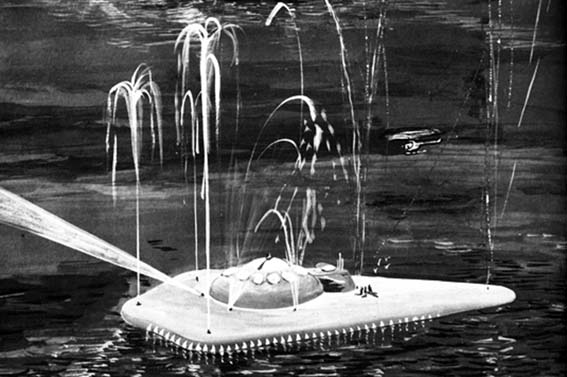
BEA. The traveling underwater chapel proposed by Mark Mills for American post-conciliar liturgy
DOI:
https://doi.org/10.17979/aarc.2013.3.0.5089Keywords:
counterculture, chapel, Mark Mills, mobile architecture, ecumenicalAbstract
In 1970 father Joseph Champlin writes: «the vast majority waits this new epoch in the life of our church». Mark Mills develops in 1971 the project BEA, a submarine chapel inspired in the form of a manta ray, that would travel all over the world becoming a«marine symbol consecrated to peace». The proposal, seen as a realistic project, follows the research of countercultural archi- tectures next to Fuller’s, in which the habitat of man and his relationship with nature and the community become essential elements of the project, defining a more cognitive and sensible space but symbolic or figurative.
Downloads
References
Buckminster Fuller, Richard y Jaime Snyder. 2008. And they Came to pass not to Stay. Middlesex: Penguin Books Ltd.
Champlin, Joseph. 1970. «A New Epoch in the Liturgy», Liturgical Arts 38: 82-83.
Comité Ad Hoc de la Ciudad Instantánea. 1971. Manifiesto. Ibiza: Comité Ad Hoc.
Crippa, Maria Antonietta. 2011. «A Dwelling for Man within the Harmony of the Cosmos». En The Religious Imagination in Modern and Contemporary Architecture: A Reader, editado por Renata Hejduk y Jim Williamson, 104-110. New York: Routledge Taylor and Francis Group.
Le Ricolais, Robert. 1997. Visiones y Paradojas. Madrid: COAM.
Pallasmaa, Juhani. 2011. «The Aura of the Sacred: Art, Architecture and Existential Sacredness». En The Religious Imagination in Modern and Contemporary Architecture: A Reader, editado por Renata Hejduk y Jim Williamson, 234-241. New York: Routledge Taylor and Francis Group.
Pierce, Joanne M. 2008. «A Chapel on the Moon: Reflections on Roman Catholic Liturgical Imagination in 1967 and 2007», Colloquium: Music, Worship, Arts 5: 11-26. Consultado el 20/08/2013, http://www.yale.edu/ism/colloq_journal/vol5/index.html.
Rougerie, Jacques. 1974. «Urbanisme et architecture de la mer», Architecture d’aujourd’hui 175: 66-76.
Sagrada Congregación para el Culto Divino y la Disciplina de los Sacramentos. 1970. Ordenación General del Misal Romano. Consultado el 21/07/2013, http://www.ewtn.com/library/curia/girmall.htm.
Scott, Felicity D. 2007. Architecture or Techno-Utopia: Politics after modernism. Cambridge: MIT University Press.
Songel Gonzalez, Josep María. 1997. Frei Otto, Barcelona: Artes Gráficas Campás.