

Announcements
Digital well-being and responsible disconnection policy
2026-04-30
Editorial commitment
The Journal of Studies and Research in Psychology and Education, published by the Universidade da Coruña, assumes an explicit commitment to digital well-being, psychosocial health, and the sustainability of academic work, in line with the current regulatory framework, international best publishing practices and the values of the public university.
This commitment is aligned with current regulations, international editorial best practices, and the values of the public university system.
Within this framework, the journal adopts organizational criteria aimed at promoting responsible academic communication, avoiding dynamics that foster hyperconnectivity, permanent availability, or unnecessary time pressure on authors, reviewers, and the editorial team.
1. Regulatory Framework
1.1 Right to Digital Disconnection
The right to digital disconnection is recognized in the Spanish legal system, particularly in Article 88 of Organic Law 3/2018 on Personal Data Protection and Guarantee of Digital Rights (LOPDGDD).
This right ensures respect for rest periods, work–life balance, and protection against risks derived from the intensive use of digital technologies.
Although scientific editorial activity does not imply a direct employment relationship with authors and reviewers, it does structure digitally mediated academic work practices; therefore, it is appropriate to adopt measures that prevent environments incompatible with these principles.
1.2 Application to the Academic Ecosystem
University editorial activity is primarily carried out in digital environments (editorial management platforms, email, asynchronous review processes, and international collaboration), which may encourage situations of hyperconnectivity.
This context reproduces widely identified psychosocial risks, such as the blurring of boundaries between personal and professional time or pressure for constant availability.
1.3 Jurisprudential Considerations
Recent case law has reinforced a preventive interpretation of the right to digital disconnection, indicating that the systematic sending of communications outside working hours may infringe this right, even without requiring an immediate response.
This approach highlights the responsibility of organizations—including academic institutions—to avoid practices that normalize permanent availability.
2. Digital Well-being and Prevention of Psychosocial Risks
Digital disconnection constitutes a preventive measure against risks such as technostress, mental overload, or professional burnout.
From this perspective, responsible management of editorial communication times and channels contributes to:
• improving the quality of scientific work,
• protecting the health of those involved,
• and fostering sustainable academic practices in the long term.
3. Alignment with University Best Practices
Various public universities have incorporated formal digital disconnection policies applicable to their teaching and research staff.
Among the most relevant principles, transferable to the editorial context, are:
• avoiding unnecessary communications outside reasonable hours,
• not equating academic urgency with digital immediacy,
• promoting organizational cultures that respect rest periods.
The adoption of these criteria places the journal in line with emerging standards in the university system.
4. Editorial Principles
In line with the above, the journal establishes the following principles:
• Editorial deadlines will be set according to reasonable and proportionate criteria, avoiding unjustified urgency.
• Editorial communications will preferably take place on working days (Monday to Friday), within regular working hours.
• The sending of communications outside these periods will not, under any circumstances, imply an expectation of an immediate response.
• Authors and reviewers will not be penalized for not responding during weekends, public holidays, or vacation periods.
• The journal promotes an academic culture based on rigor, quality, and respect for personal time.
Final Statement
Scientific excellence is incompatible with sustained hyperconnectivity.
Promoting digital well-being does not limit academic activity; it makes it more ethical, sustainable, and of higher quality.
The Journal of Studies and Research in Psychology and Education understands that caring for the people who produce and evaluate scientific knowledge is an essential part of editorial responsibility.
On the occasion of International Workers' Day, the journal reaffirms this commitment.
New Indexing
2026-03-27
We are pleased to announce that the Journal of Studies and Research in Psychology and Education has been included in the Diamond Discovery Hub (DDH) of the European Diamond Capacity Hub (EDCH), following a positive evaluation by the Spanish Foundation for Science and Technology (FECYT).
This recognition confirms that the journal adheres with the principles of the Diamond Open Access model, which is characterised by open access at no cost to authors and readers, the use of open licences, and a commitment to high-quality, accessible scientific publication serving the academic community.
You can view our listing via the following link:
https://ddh.edch.eu/en/journals/19931
We would like to thank FECYT for its work in evaluating and supporting scientific journals, as well as everyone who contributes to the development and consolidation of this journal.
This achievement reinforces our commitment to editorial quality and to a model of open, inclusive and sustainable science.
Reviewers 2025
2026-02-02
The editorial team of the Revista de Estudios e Investigación en Psicología y Educación would like to thank those who dedicated their time and expertise to reviewing manuscripts in 2025. Their excellent work and valuable contributions have helped to improve the quality of the articles published and the journal itself. A total of 63 persons from 11 different countries have participated. The complete list can be found under the ‘About’ tab or by clicking HERE.
If you have not yet participated as an external reviewer for this journal but would like to do so in the future, please email at reipe@udc.es
Visits received in 2025
2026-02-02
We present the readership statistics for the Revista de Estudios e Investigación en Psicología y Educación for the year 2025.
In total, there were more than 400,000, with an average of more than 30,000 per month. This is 40% more than the previous year..
Many thanks to those of you who follow our publications with interest, read us and cite us!
Be sure to check out the current issue and previous issues. You will find articles that will interest you.

Good news to start the year: FECYT Seal
2026-01-02

The Revista de Estudios e Investigación en Psicología y Educación is pleased to announce that it has obtained the prestigious FECYT Seal of Editorial and Scientific Quality, awarded by the Spanish Ministry of Science, Innovation and Universities.
The criteria used (in brief) were:
- Editorial quality (regularity, transparency, visibility, impact, ethics, open science and gender perspective, among other aspects) and scientific quality (impact and influence on the community).
- Editorial management, transparency, integration of open science and gender perspective.
- Visibility and impact (presence in databases and scientific impact through standardised bibliometric indicators).
- Relevance, originality and rigour of content.
It has also obtained the Mention of Good Editorial Practices in Gender Equality, an award given to ‘journals that integrate explicit equality policies, balanced composition in editorial bodies, use of inclusive language and gender analysis in research, in line with European policies’.
The list of Spanish scientific journals that obtained the aforementioned Seal was published a few days ago and can be consulted HERE:
Thank you very much for the trust you have placed in our journal by reading it, submitting articles for publication and making evaluations manuscripts.
Happy 2026!

Reviewers 2024
2025-02-01
The Revista de Estudios e Investigación en Psicología y Educación wishes to thank the many people who have disinterestedly participated as reviewers during the year 2024, for the excellent work done and their invaluable contribution to the quality of the articles published and the journal itself.
The list can be consulted in the "About" tab or by clicking HERE.
Readings 2024
2025-01-25
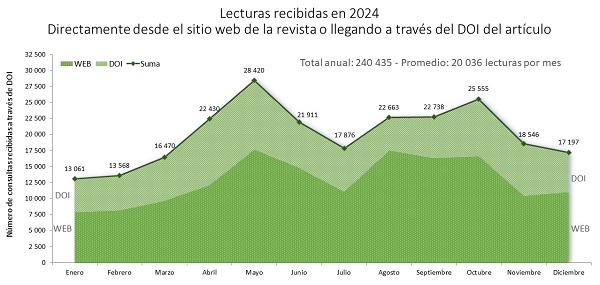
We present the readership statistics for the Journal of Studies and Research in Psychology and Education for the year 2024.
We are pleased to report that there were more than two hundred and forty thousand: more than twenty thousand per month on average.
Many thanks to those of you who follow our publications with interest, read us and cite us!
Be sure to come back to see the current and previous issues.
Continuous publication of articles and reviews, starting in 2025
2024-12-07
We are pleased to inform all those who follow our publications that, from 2025, we will move to a ‘continuous publication’ format (replacing the current full issue format). The first issue will cover January-June and the second July-December. Articles will be assigned to the open issue and will be published as they receive final acceptance.
REDALYC membership
2023-02-24
It is with great satisfaction that we report that the Revista de Estudios e Investigación en Psicología y Educación is now officially part of the REDALYC Scientific Information System infrastructure, which promotes Diamond Open Access. This was achieved, first, by satisfactorily meeting the criteria of the different phases of the evaluation process: internal qualification, ratification by the management and qualitative assessment by the Journal Evaluation Board. Subsequently, by meeting the digitalisation criteria required by this indexing system. REIPE is grateful for all the support and attention received from the members of the REDALYC team, who always responded quickly and kindly to the doubts that arose during the process of incorporation into the aforementioned infrastructure.